

How To Reduce CAC Across Your Brand Search Campaigns
If you run brand search campaigns in a regulated industry, a large share of your budget pays for users who have already converted. Google blocks the customer-list exclusions that would normally fix this, so converted users click your paid ad instead of your organic listing and you pay full CPC for nothing. Shadow campaigns and click frequency validation rules route those repeat clickers to a lower-cost duplicate campaign, cutting wasted spend by 20 to 50% while keeping full coverage on the SERP.
If you are running brand search campaigns in a regulated industry, a significant portion of your budget is being spent on users who have already converted. Not because your targeting is wrong, but because the platform does not give you the tools to fix it.
In iGaming, financial services, healthcare, and other regulated verticals, Google restricts the use of first-party data for audience targeting. You cannot build customer match lists. You cannot create remarketing audiences. You cannot exclude existing users from your brand auctions.
The consequence: your converted users search your brand name, click a paid ad instead of the organic listing, and you pay full CPC for a visit that would have happened for free. Across the operators and advertisers TrafficGuard works with, this returning-user behaviour typically consumes 15 to 25% of total brand campaign spend.
Shadow campaigns are the strategy designed to solve this. This guide explains the problem from first principles, walks through the technical setup, and gives you the benchmark data to build a business case.
Why Returning Users are Inflating your Brand Search CAC
In an unrestricted advertising environment, solving for returning users is straightforward. You upload a customer list, create a negative audience, and exclude those users from your brand campaigns. Google even offers Customer Match specifically for this purpose.
But in regulated industries, this option does not exist. Google classifies gambling, certain financial products, and healthcare as sensitive categories. Advertisers in these verticals are prohibited from using customer lists for targeting or exclusion. The result is a structural inefficiency that cannot be solved with standard Google Ads features.
What happens in practice:
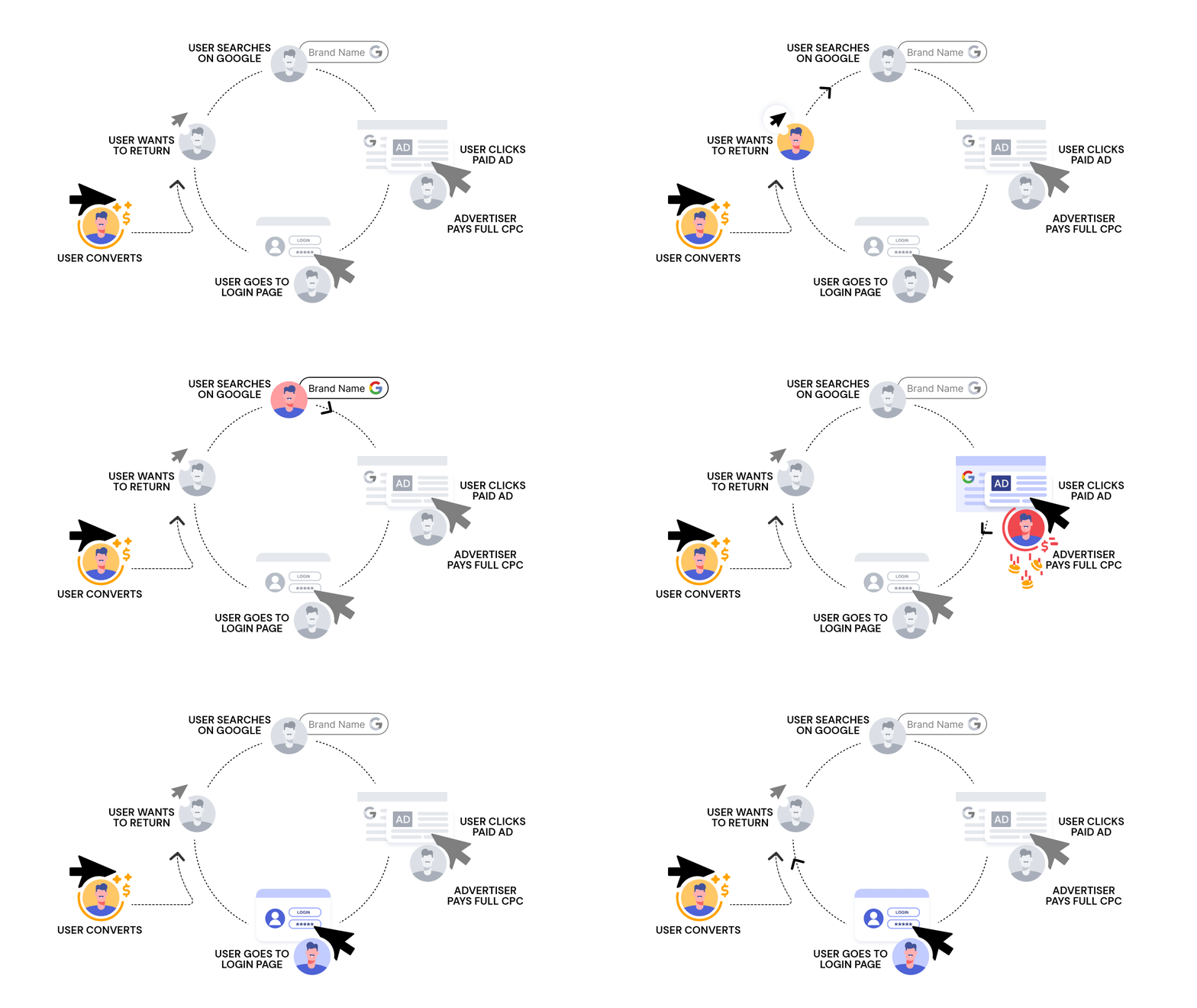
- A user discovers your brand through a paid ad and converts (registers, deposits, signs up).
- Days or weeks later, they want to return to your site. Instead of typing the URL or using a bookmark, they search your brand name on Google.
- Google serves a paid ad at the top of the SERP. The user clicks it because it is the first thing they see.
- You pay full CPC for a user who was already your customer. They go straight to the login page. Zero incremental value.
This is not fraud. It is not even necessarily invalid traffic. It is a structural waste problem built into how Google Ads works in regulated markets. See how TrafficGuard protects invalid traffic on Google Search ads.
How 2 to 5% of Clickers Consume 15 to 20% of Your Brand Budget
Before implementing any solution, it is worth understanding the scale of the problem. Click frequency analysis measures how many times each unique user clicks your ads within a 24-hour period.
Across the advertisers TrafficGuard works with globally, the pattern is remarkably consistent:
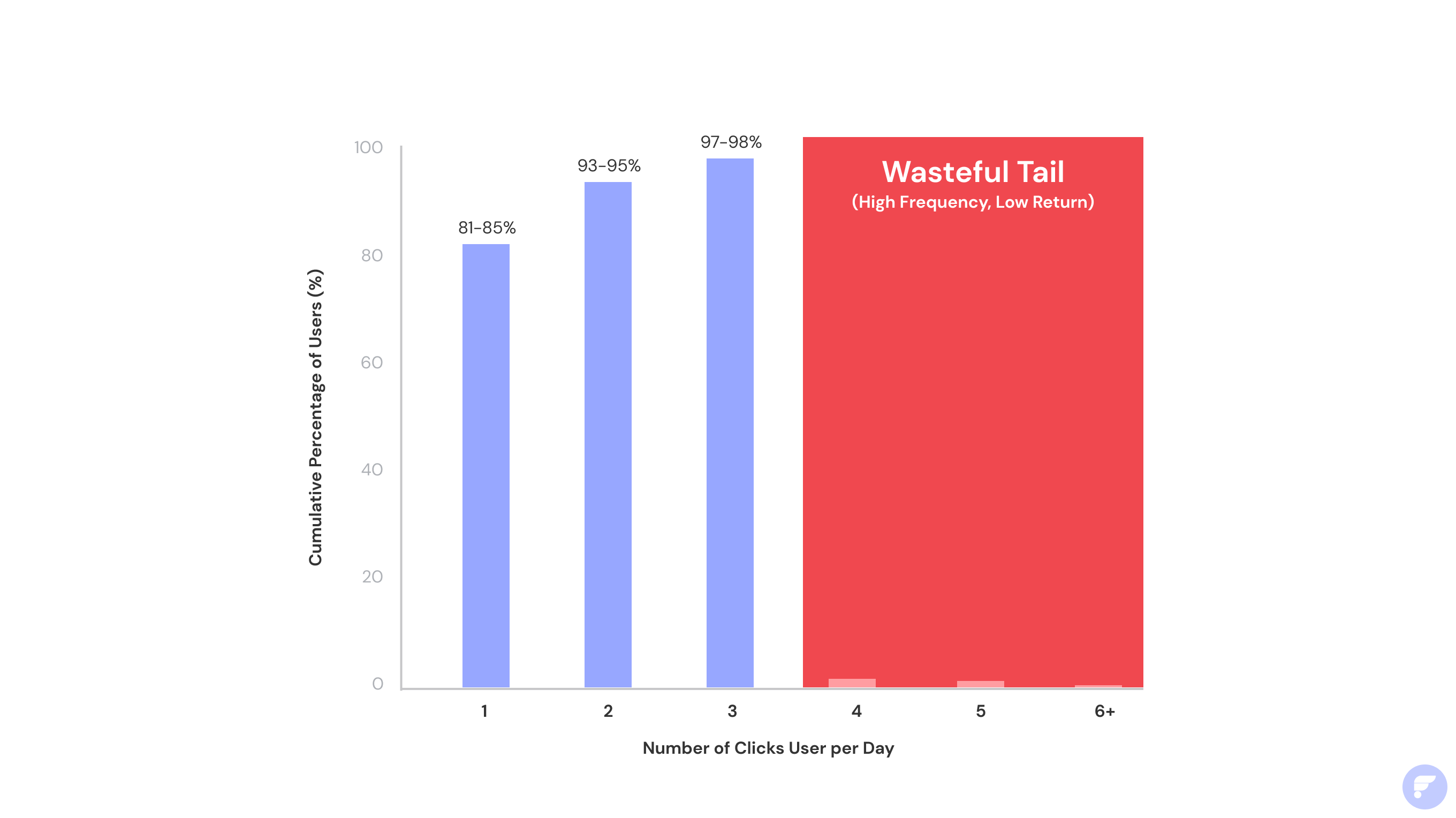
- 81 to 85% of users click once per day. These are genuine prospectors or first-time visitors.
- 93 to 95% of users click no more than twice per day.
- 97 to 98% of users click no more than three times per day.
That leaves 2 to 5% of users who click four or more times daily. This small cohort typically accounts for 15 to 20% of your total brand campaign budget.
When you examine these high-frequency clickers in detail, the pattern is clear: they are going straight to the login page on every visit. They are already converted. They are using your paid ads as a bookmark.
In a market where brand CPCs range from $5 to $200 or more, the financial impact is substantial. An operator spending $750,000 per quarter on brand search can expect $112,000 to $150,000 of that to be consumed by returning users clicking four or more times daily.
What Shadow Campaigns Are and How They Cut Wasted Spend
A shadow campaign is a duplicate of your primary brand campaign, configured with a significantly lower CPC, that serves ads to users who have exceeded your click frequency threshold on the primary campaign.
Think of it as an optimisation layer that sits on top of fraud prevention. Blocking invalid traffic stops bad clicks. Shadow campaigns go a step further and reduce what you pay for genuine-but-non-incremental clicks, using validation rules rather than outright exclusion.
The concept is simple:
- Primary campaign: Serves your standard brand ads at full CPC to all users.
- Click frequency rule: Monitors each user and counts how many times they click within a 24-hour window.
- Threshold exceeded: When a user clicks more than your defined limit (typically 3), their IP is excluded from the primary campaign.
- Shadow campaign activates: The user searches again. The primary campaign no longer serves them. Google automatically serves the shadow campaign ad instead, at the reduced CPC.
- Full SERP coverage maintained: The user still sees your ad. They still click. They still reach your site. You simply paid around 50% less for that click.
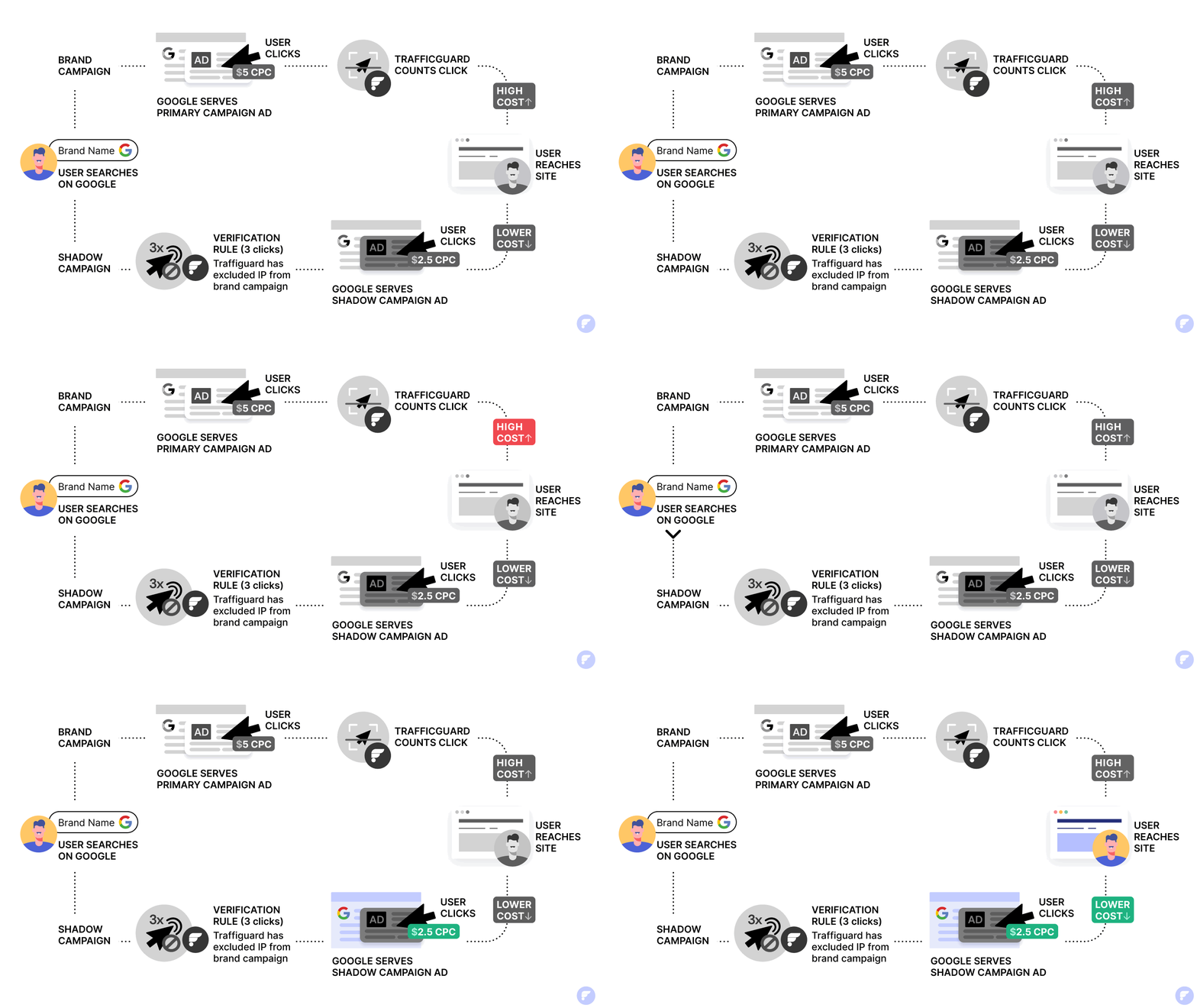
The key distinction between shadow campaigns and simply cutting off ad serving entirely: you never leave a gap on the SERP for a competitor to fill. This is critical in competitive markets where rivals actively bid on each other's brand terms.
TrafficGuard's validation rules work at both the account and campaign level, so you can apply one global click frequency policy or tune thresholds campaign by campaign. That flexibility matters once you are managing exclusions at scale.
How To Set Up Shadow Campaigns in Three Steps
Step 1: Duplicate your brand campaign
In Google Ads, create an exact copy of your primary brand campaign. Same keywords, same ad copy, same ad extensions, same targeting. Name it clearly, for example "Brand Campaign - Shadow".
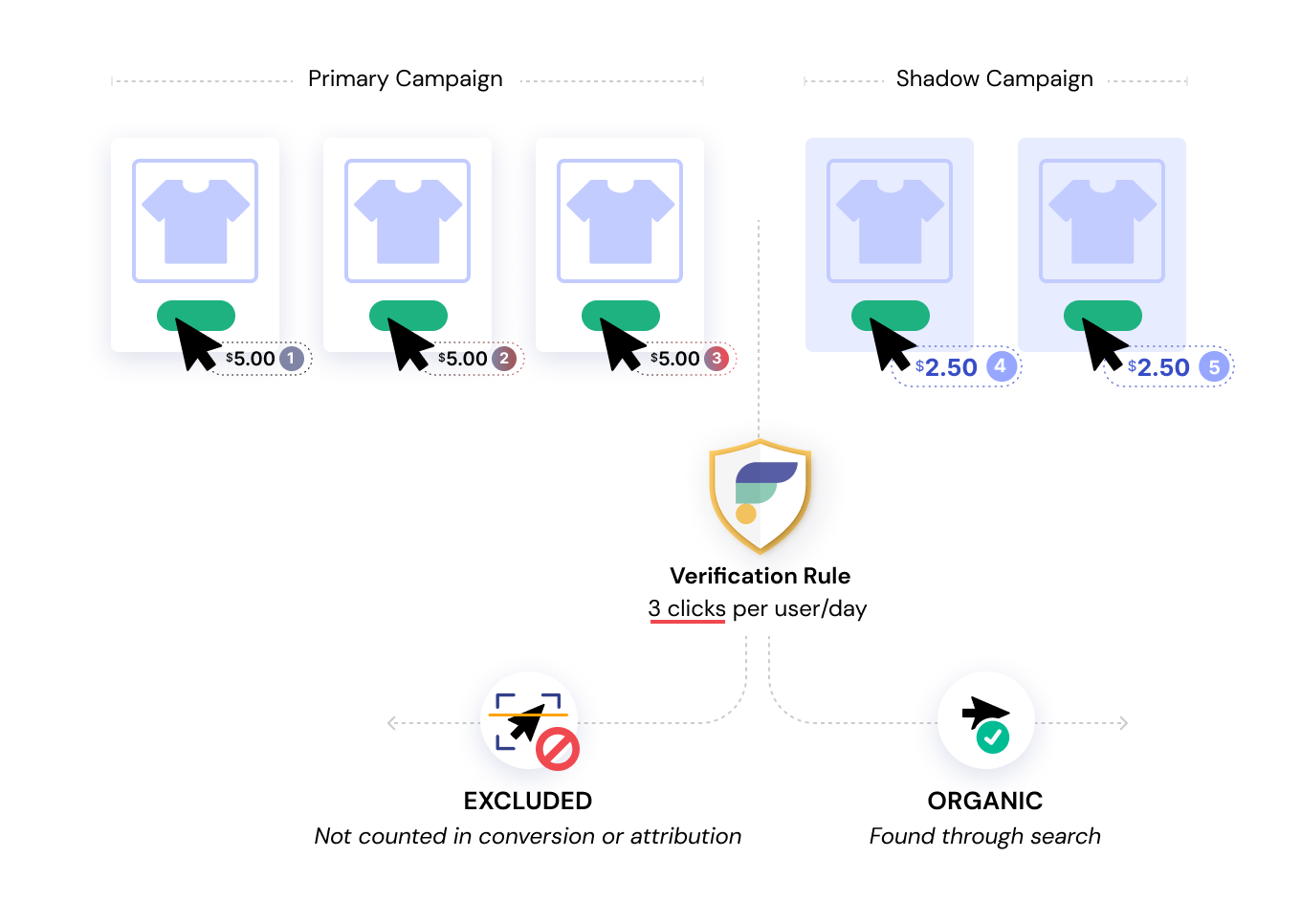
Set the bidding strategy to Manual CPC at approximately 50% of your primary campaign's average CPC. If your primary campaign averages $5.00 CPC, set the shadow at $2.00 to $2.50.
Pro tip: use Google's auction insights to identify the first and third position bid estimates for your brand terms. Set your shadow campaign CPC to remain within the top three positions. This ensures the returning user still sees your ad prominently, even at the reduced bid.
Step 2: Configure click frequency validation rules
Within TrafficGuard, navigate to Settings and then Verification Rules. Create a Click Frequency rule with the following parameters:
- Frequency threshold: 3 clicks per user
- Time window: 24 hours
- Apply to: Primary brand campaign only (not the shadow)
- Action: Exclude user IP from primary campaign for 24 hours
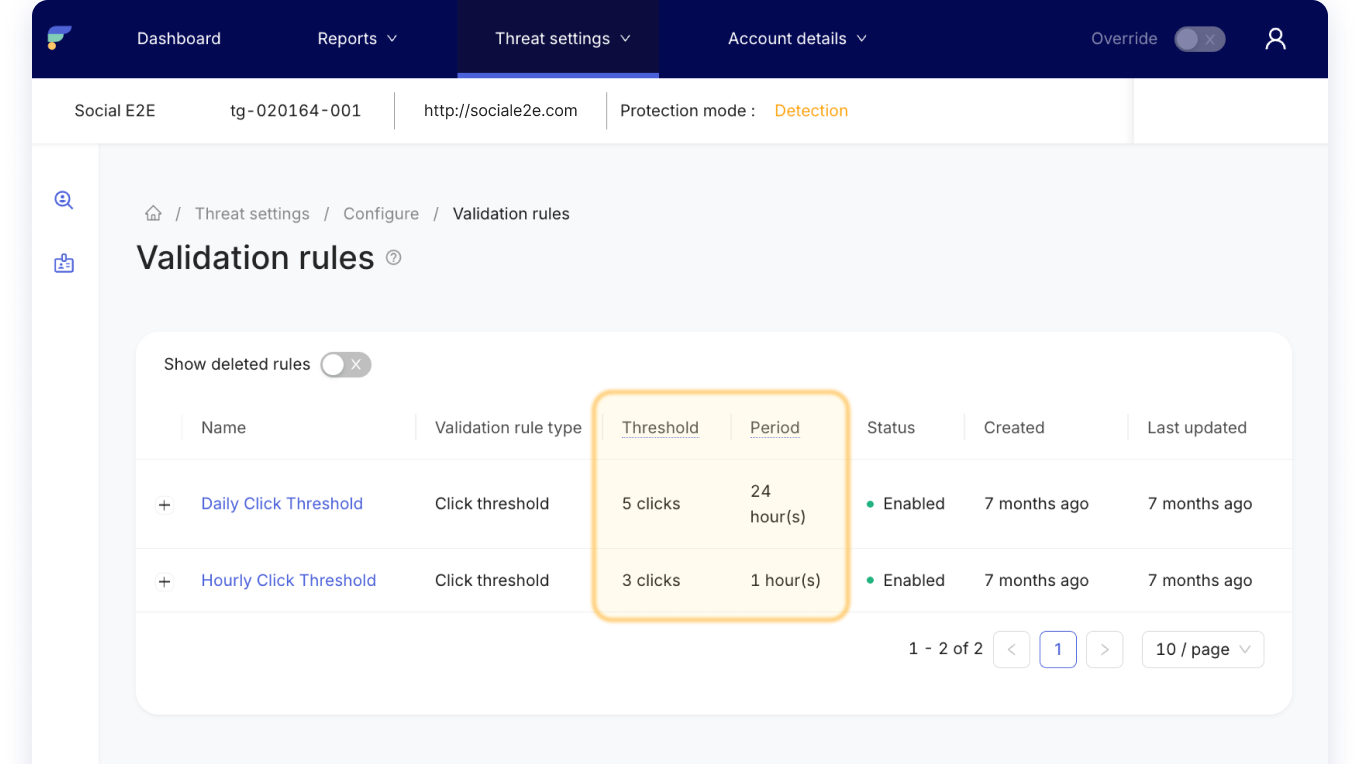
When a user clicks their first, second, and third time, everything operates normally on the primary campaign at full CPC. On the fourth click, TrafficGuard pushes their IP to the primary campaign's exclusion list. Google then serves the shadow campaign instead.
Step 3: Monitor and optimise
After the first two weeks, review the click frequency data within TrafficGuard. You will see:
- The exact percentage of users exceeding your threshold
- The budget consumed by those users on the primary versus shadow campaign
- Post-click behaviour (login page visits versus new registrations)
- Pay-to-organic conversion data showing users who return organically after exclusion
Most operators start conservatively with a threshold of 5 and gradually reduce to 3 over the first month as they gain confidence in the data.
Budget Impact: What To Expect
The financial case for shadow campaigns is straightforward. Here is a worked example based on typical operator data:
- Monthly brand campaign spend: $250,000
- Average CPC (primary): $5.00
- Total monthly clicks: 50,000
- Users clicking 4+ times daily: 5% (2,500 users)
- Average clicks per high-frequency user: 6 per day
Without shadow campaigns: those 2,500 users generate roughly 15,000 clicks per month at $5.00 each, or $75,000 in returning-user spend.
With shadow campaigns (threshold of 3): each user gets 3 clicks at $5.00 ($15), then subsequent clicks at $2.50. Monthly saving on those users: approximately $37,500 per month, or $450,000 annually.
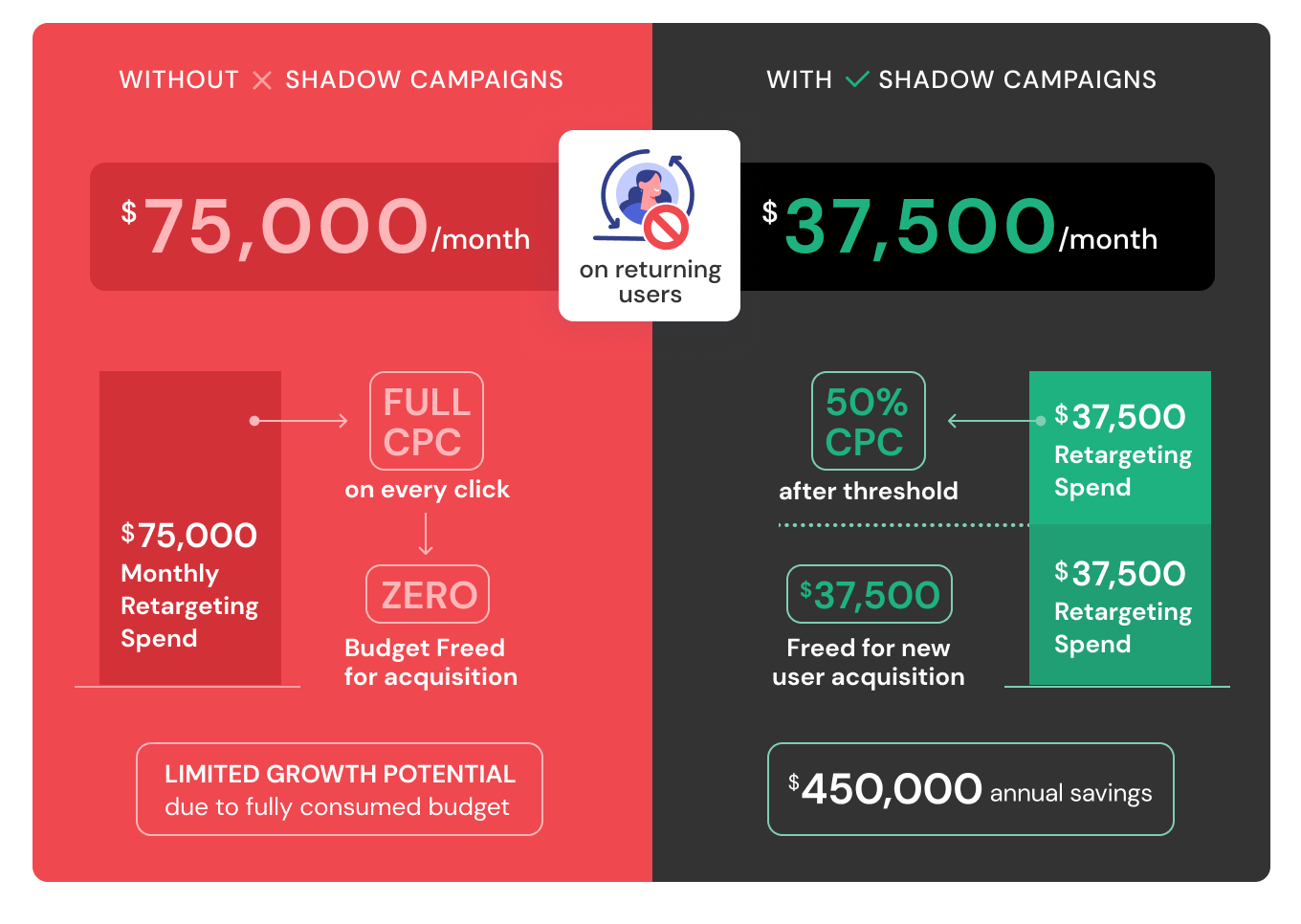
This freed budget can be redirected to top-of-funnel acquisition campaigns targeting genuine new users, improving overall CAC and increasing first-time depositor volume.
Want to see what shadow campaigns could save on your brand spend? Get your free brand search audit.
How To Work Around Google's 500 IP Exclusion Limit
One practical concern with this strategy is Google's 500 IP exclusion limit per campaign. If you are a large advertiser with thousands of returning users, how do you manage exclusions at scale?
Three mechanisms make this work:
- Dynamic rotation. TrafficGuard continuously rotates IPs on and off the exclusion list based on recency. IPs that have not been seen in the last 24 hours are removed to make room for newly identified returning users. The list is always optimised for current, active offenders.
- IP range condensation (CIDR blocking). When multiple returning users share similar IP ranges (common with ISP allocations), TrafficGuard condenses those individual IPs into a single CIDR range. One exclusion slot can then cover dozens or hundreds of IPs, dramatically extending the effective capacity of the 500-slot limit.
- Campaign-level exclusions multiply your capacity. The 500 limit applies per campaign, not just at the account level. By applying exclusions at the campaign level, you effectively have 500 slots on each campaign plus 500 at the account level. For an advertiser with 10 campaigns, that is 5,500 potential exclusion slots.
How To Prove Shadow Campaigns Are Not Losing You Traffic
The most common objection to shadow campaigns is: "what if I exclude a user and they go to a competitor instead of coming back organically?"
This is a valid concern, and it is why post-exclusion tracking matters. TrafficGuard's site tag monitors what happens after a user is excluded from both the primary and shadow campaigns. Specifically, it tracks whether that user returns to your site through organic search, direct navigation, or any other non-paid channel.
Across the operators TrafficGuard works with, the data consistently shows that the vast majority of excluded returning users come back organically. They are loyal, logged-in customers. They are not comparison shopping. They just need a nudge to stop using Google as a shortcut, and removing the paid ad from their path is that nudge.
When Shadow Campaigns Work Best
Shadow campaigns deliver the strongest results in environments with the following characteristics:
- High brand CPCs (typically $5+ per click, with the biggest impact at $50+)
- Regulated industries where audience exclusion lists are not permitted
- Strong brand recognition with a high volume of branded search traffic
- Loyal, repeat-visit user base (for example sports bettors, casino players, financial platform users)
- Competitive brand auctions where competitors bid on your brand terms
If your brand campaigns run in an unregulated vertical where you can use Customer Match and negative audiences, you likely do not need shadow campaigns. The standard Google Ads tools will suffice. Shadow campaigns exist specifically to solve the gap that regulation creates. For a vertical-specific walkthrough, see how fintech advertisers apply shadow campaigns to stop paying premium CPC for users who already know them, or how sports betting operators protect brand spend from returning users.
See What Returning Users Are Costing You
TrafficGuard provides a free two-week audit of your Google Ads account. We will show you exactly how many returning users are clicking your brand ads, how much they are costing, and what shadow campaigns would save you. Setup takes 20 to 30 minutes with no disruption to your live campaigns.
Get your free brand search audit.
Frequently Asked Questions About Shadow Campaigns
What is a shadow campaign in Google Ads?
A shadow campaign is a duplicate of your primary brand search campaign, configured with a lower CPC and click frequency rules. It serves ads only to users who have already exceeded a set click threshold (typically 3 clicks in 24 hours). The goal is to reduce what you pay for returning users who would likely convert through organic results anyway, without losing coverage for genuine new visitors.
How much can shadow campaigns reduce brand search CAC?
Most advertisers running shadow campaigns see a 20 to 50% reduction in brand search CAC, depending on how large their returning-user segment is. Brands in regulated industries (iGaming, finance, travel) with high repeat-visit rates and restricted customer list usage tend to see savings at the higher end of that range.
Will excluding returning users send them to competitors instead?
This is the most common concern, and the data does not support it. Returning users who are excluded from your paid ad still see your organic listing. Pay-to-organic tracking shows the vast majority of these users click through organically rather than switching to a competitor. Shadow campaigns reduce spend on users who were never incremental to begin with.
Why is my CPA so high on Google Ads brand campaigns?
High brand CPAs are usually caused by a large share of returning or already-converted users clicking your paid ads repeatedly. These users inflate your click volume without adding new conversions. Click frequency analysis typically reveals that 2 to 5% of users clicking 4+ times daily account for 15 to 20% of total brand spend. Shadow campaigns address this by routing high-frequency clickers to a lower-CPC campaign.
What are validation rules in TrafficGuard?
Validation rules (also called verification rules) are conditions you set in TrafficGuard to control how your ads serve beyond basic fraud prevention. A click frequency rule is one example: it counts how many times each user clicks within a time window and triggers an action, such as excluding their IP, once a threshold is crossed. Validation rules work at both the account and campaign level.
Can you exclude existing customers from brand search campaigns in regulated industries?
No. Google classifies gambling, many financial products, and healthcare as sensitive categories, which blocks Customer Match and customer-list audience exclusions for advertisers in those verticals. That restriction is the root cause of returning users clicking your paid brand ads. Shadow campaigns are the workaround: rather than excluding the user, you route their repeat clicks to a lower-CPC duplicate campaign, so you keep your SERP position at a fraction of the cost.
How do you set up a shadow campaign in Google Ads?
Setting up a shadow campaign takes three steps. First, duplicate your primary brand campaign and set its Manual CPC to roughly 50% of the original. Second, create a click frequency validation rule in TrafficGuard, typically 3 clicks per user in 24 hours, that excludes a user's IP from the primary campaign once they exceed the threshold. Third, monitor the data for two weeks and tighten the threshold as confidence grows. Once a user is excluded from the primary campaign, Google automatically serves the lower-cost shadow campaign instead.
How does TrafficGuard handle Google's 500 IP exclusion limit?
TrafficGuard works around Google's limit of 500 IP exclusions per campaign with three mechanisms: dynamic rotation that removes IPs not seen in the last 24 hours, CIDR range condensation that collapses many similar IPs into a single exclusion slot, and campaign-level exclusions that multiply capacity (500 slots per campaign plus 500 at the account level). For an advertiser running 10 campaigns, that is up to 5,500 exclusion slots.
The Bottom Line
Returning users are not a targeting failure, they are a structural cost that regulation forces on brand search campaigns. Shadow campaigns paired with click frequency validation rules let you stop paying full CPC for customers you already won, while keeping full visibility on the SERP. Start by measuring how many of your clickers exceed three clicks a day, then route them to a lower-cost shadow campaign. Protect your Google Search campaigns with TrafficGuard or book a free brand search audit to see the saving on your own account.
Get started - it's free
You can set up a TrafficGuard account in minutes, so we’ll be protecting your campaigns before you can say ‘sky-high ROI’.

Explore More Blogs

Subscribe
Subscribe now to get all the latest news and insights on digital advertising, machine learning and ad fraud.


