

The 4 Stages of Ad Fraud Prevention Maturity

Most advertisers sit lower on the ad fraud prevention curve than they think. Detecting fraud after a campaign ends, or blocking it at a single point, still leaves budget exposed and conversion data dirty. This guide maps the four stages of ad fraud prevention, from doing nothing to real-time, multi-point defence, and shows how to move up. The jump that matters most is the one from seeing fraud to stopping it before you pay.
Your cost per acquisition is creeping up, volume looks healthy, and nobody can explain why. That gap is often what weak ad fraud prevention looks like in practice. Invalid clicks drain budget, corrupt the conversion data your bidding relies on, and reward the sources sending fake traffic. TrafficGuard built its platform on one principle: knowing fraud exists is not the same as stopping it.
Ad fraud prevention is the practice of identifying and blocking invalid traffic, bots, and fraudulent clicks before they consume ad budget or distort campaign data. Maturity describes how far an advertiser has moved from reacting to fraud after the damage is done to preventing it in real time, across every stage of the ad journey. Knowing where you sit is the first step to protecting return on ad spend and trusting your numbers again.
What Ad Fraud Prevention Maturity Actually Measures
Maturity is not about how much you spend on tooling. It measures one thing: how early in the ad journey you can act on invalid traffic. At the low end, fraud is invisible and unchallenged. At the high end, it is neutralised before your budget ever reaches a fraudulent click.
The distinction that trips most teams up is the difference between detection and prevention. Detection tells you fraud happened. Prevention stops you paying for it. You can have detailed reports showing invalid traffic across every campaign and still lose the same budget every month, because the report arrives after the click has already been bought. That is the trap of the middle stages, and it is where a surprising number of sophisticated advertisers are stuck.
There is a second, quieter problem. Every invalid click that gets through does not just waste money, it teaches your bidding algorithm the wrong lesson. Smart Bidding and Meta Advantage+ optimise toward the conversions they are shown. Feed them contaminated data and they will chase fake signals, compounding the damage long after the original click. Clean prevention protects the inputs, not just the invoice.
A final trap is mistaking visibility for protection. A dashboard full of fraud metrics feels like control, but a report you cannot act on in real time is just a record of budget you have already lost. Maturity is measured by what you stop, not by what you can see. Advertisers routinely have rich reporting and thin defences at the same time, which is why so many plateau in the middle of the model without realising it.
The Four Stages of Ad Fraud Prevention
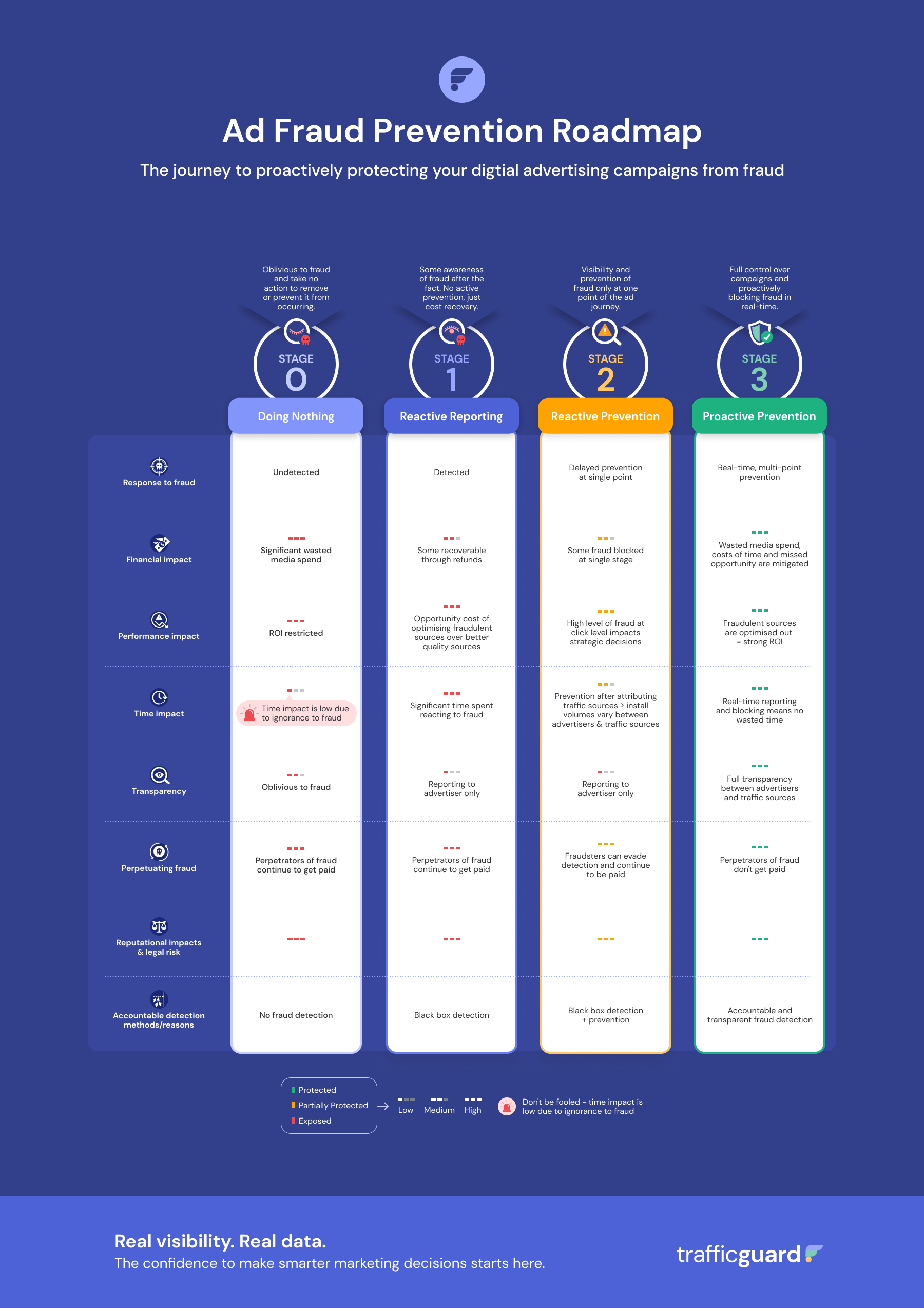
Stage 0: Doing nothing
Fraud is undetected and unchallenged. Budgets leak, performance stalls, and fraudulent sources get paid without question. The response to fraud is none, because nobody is looking. The impact is high wasted spend, zero visibility, and a steady transfer of budget to bad actors. The uncomfortable reality is that most teams here believe their campaigns are fine. Ignorance is not free, it is just invisible.
Stage 1: Reactive reporting
Fraud is detected, but only after the damage is done. Some recovery is possible through platform refunds, yet there is no active prevention. You know fraud is happening and you can quantify it, which feels like progress. It is not enough. You are still paying for every invalid click first and clawing back a fraction later, while the bad data has already reached your bidding models. Reporting without blocking is an audit trail, not a defence.
Stage 2: Reactive prevention
Now some fraud is blocked, but only at a single point in the campaign journey, usually click level on one channel. Protection is real but partial. High volumes of invalid traffic still slip through elsewhere and continue to shape your strategy and audience data. This is better than reporting alone, and it is where many advertisers plateau. The gap is coverage. A threat blocked on Search that walks straight into your Meta or affiliate spend has not been prevented, it has been redirected.
Stage 3: Proactive prevention
Fraud is detected and blocked in real time, at multiple points across the ad journey, before budget is spent. Full transparency between advertisers and traffic sources means bad actors do not get paid. The impact is cleaner traffic, accurate data, and stronger return on ad spend. At this stage you are in control. Threats are neutralised before they cause damage, your conversion data reflects real users, and your optimisation decisions rest on signals you can trust.
Why This Matters for eCommerce
The cost of staying at the low end is not abstract. Juniper Research forecasts that advertising fraud will cost businesses $172 billion globally by 2028, and Statista put the figure at roughly $100 billion as far back as 2023. This is not a rounding error in the industry, it is a structural tax on performance marketing.
For eCommerce and DTC brands running high-volume paid search and paid social, the exposure is acute. TrafficGuard's work with performance advertisers shows that up to 20% of ad spend can be wasted on invalid or fraudulent traffic in eCommerce campaigns. On a $50,000 monthly Search budget, the entry point for most performance teams, that is up to $10,000 a month buying clicks that will never convert.
The damage does not stop at wasted spend. Invalid traffic inflates CPCs, distorts return on ad spend, and feeds contaminated conversion data straight into Smart Bidding and Meta Advantage+. The algorithm then optimises toward fake signals, so real acquisition efficiency degrades even on channels where your volume looks stable. Rising CPAs with no obvious cause are often the first symptom leadership notices, long after the fraud began.
There is also a subtler leak that maturity exposes. Branded search cannibalisation, where returning customers click a paid brand ad to log in, quietly inflates CPA for users who were always going to convert. It is not fraud in the classic sense, but it wastes the same budget, and low-maturity setups have no way to see it or suppress it. A mature prevention layer separates genuinely new acquisition from re-engagement clicks, so budget flows toward incremental customers rather than traffic you were already going to win.
How TrafficGuard Search Prevents Ad Fraud in Real Time
Reaching Stage 3 is a question of where and when you intervene. TrafficGuard's Search protection verifies traffic at multiple points across the ad journey and blocks invalid clicks in real time, before the budget is consumed. That is the mechanism difference that separates prevention from reporting.
Multiple points means exactly that. TrafficGuard assesses traffic before the bid, before the click is paid for, and after the visit, so signals that look clean at one stage but fraudulent across the full journey are still caught. A single click-level filter cannot see that pattern. Verifying at several points is what turns partial blocking at Stage 2 into genuine, journey-wide prevention at Stage 3.
It also separates TrafficGuard from generic blockers. Many tools operate on rule-based lists or exclude suspect audiences only after the spend has happened, which is prevention in name but reporting in effect. TrafficGuard uses machine-learning detection built for enterprise scale, validates traffic before the click is paid for, and covers Search, Meta, and affiliate channels rather than plugging a single leak.
Crucially, it works independently of the ad platforms. Google filters the invalid clicks it can definitively classify and credits some back, but it only acts in its own interest and misses competitor clicking, sophisticated bots, and affiliate fraud. An independent prevention layer catches what the platforms leave behind, which is exactly the traffic that does the most damage to a mature advertiser's data.
How to Move Up the Maturity Model
You do not have to climb one rung at a time. The steps below show the natural progression, but the fastest route is to adopt real-time prevention directly.
Moving from Stage 0 to Stage 1 starts with visibility. Collect and analyse your log data, and use basic ad fraud detection to identify suspicious activity so you can quantify the problem. Moving from Stage 1 to Stage 2 means acting on what you see: introduce automated monitoring to flag anomalies faster, and apply IP filtering to block the known fraudulent sources you have already identified.
Moving from Stage 2 to Stage 3 is the jump that changes your numbers. Adopt a real-time prevention platform that blocks threats at multiple points across the user journey, and insist on full transparency over traffic quality with reporting you can act on. If you want a structured way to get there, our guide on building a click fraud response plan sets out the steps every advertiser should take to stay ahead of evolving threats.
The Bottom Line
The distance between Stage 0 and Stage 3 is not really about stopping fraud for its own sake. It is about reclaiming wasted budget, protecting the data your bidding depends on, and making decisions you can trust. Detection tells you what already happened. Prevention decides what you pay for next.
If your CPAs are drifting and your reporting cannot explain it, you are probably lower on this curve than you would like. See where TrafficGuard puts you, and how fast you can reach real-time prevention, with a free demo of TrafficGuard for Search.
Frequently Asked Questions
How do I know which ad fraud prevention stage I am at?
If you never review traffic quality and rely only on platform reports, you are at Stage 0. If fraud only surfaces after a campaign ends and you occasionally claim refunds, you are at Stage 1. If you run basic blocking such as IP filters on one channel, you are at Stage 2. If you block invalid traffic in real time across multiple channels with full transparency, you have reached Stage 3.
Isn't Google's invalid click detection enough on its own?
No. Google filters the invalid clicks it can definitively classify and credits some back, but it operates in its own interest and only acts on what it is certain about. It does not stop competitor clicking, sophisticated bots, or affiliate fraud, and it will not clean the contaminated conversion data those clicks feed into Smart Bidding. An independent prevention layer catches the traffic Google leaves behind.
What is the difference between ad fraud detection and ad fraud prevention?
Detection identifies invalid traffic and tells you it happened, usually after the spend. Prevention blocks that traffic in real time, before your budget pays for the click. Detection produces an audit trail, prevention protects the budget and the data. Advertisers stuck at the reporting stage often have excellent detection and still lose the same money every month.
Can I skip stages and go straight to real-time prevention?
Yes. Many advertisers move directly from Stage 0 or Stage 1 to Stage 3 by adopting a real-time ad fraud prevention platform, rather than spending months in partial protection. There is no requirement to pass through reactive prevention first, and skipping it avoids paying for fraud while you wait.
Get started - it's free
You can set up a TrafficGuard account in minutes, so we’ll be protecting your campaigns before you can say ‘sky-high ROI’.

Explore More Blogs

Subscribe
Subscribe now to get all the latest news and insights on digital advertising, machine learning and ad fraud.


