
Is Invisible Traffic Quietly Rewriting Fintech Growth Economics?

In #fintech, every acquisition decision carries financial consequences. Yet many organisations still treat invalid traffic as a marketing problem rather than a strategic risk. FinTech Interview with Mathew Ratty, CEO of TrafficGuard reveal why fraudulent engagement is reshaping campaign economics, distorting performance signals, and influencing growth decisions long before warning signs appear.
Why Has Invalid Traffic Become A Boardroom Issue?
Ratty approaches advertising through the lens of capital allocation and that perspective changes the conversation. Marketing waste becomes a governance concern with direct implications for profitability.
Ratty states,
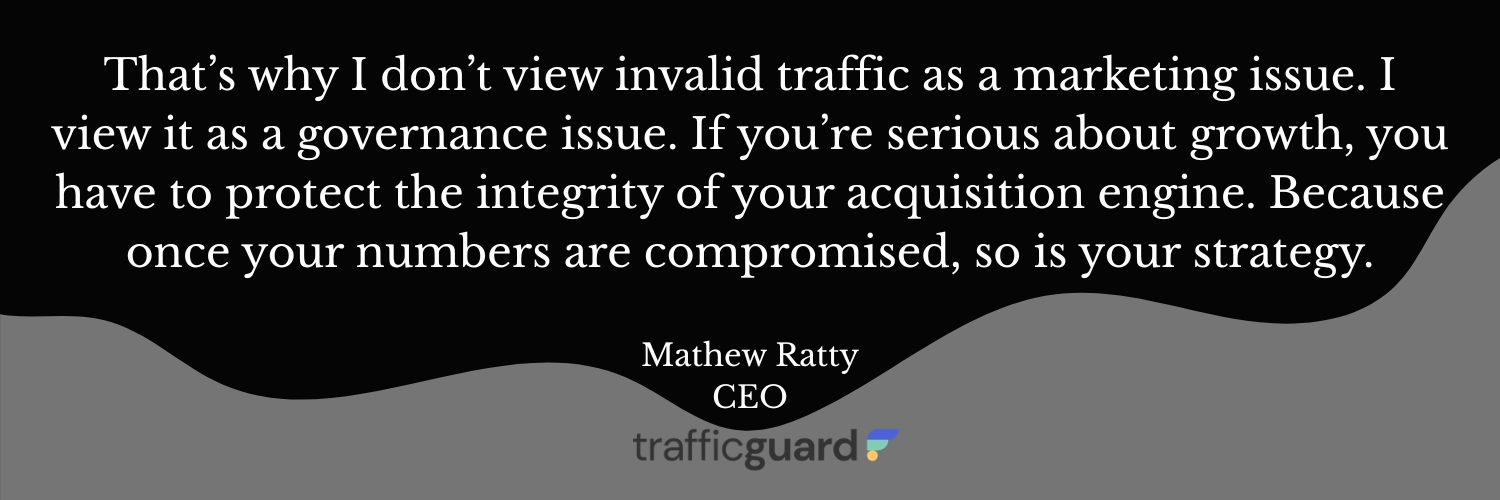
Finance leaders, revenue executives, and boards increasingly require confidence in the data guiding investment decisions. Growth becomes harder when the underlying signals cannot be trusted. For regulated industries, inaccurate performance data can influence compliance planning, market expansion decisions, and investor expectations.
Even modest levels of invalid traffic may produce outsized financial consequences when campaigns target specialised audiences and competitive search terms across regions and channels.
How Are AI-Driven Bots Reshaping Fintech Advertising?
The evolution of fraudulent traffic has accelerated alongside automation. Modern bots can replicate browsing patterns, engagement behaviour, and user activity with remarkable accuracy. What once appeared as obvious fraud now resembles legitimate customer intent that creates a serious challenge for automated bidding systems. Algorithms react to engagement patterns without understanding whether the engagement reflects genuine demand. As a result, platforms may increase bids, redirect budgets, and optimise toward low-value sources. The impact can continue long after the original activity disappears.
Ratty warns,
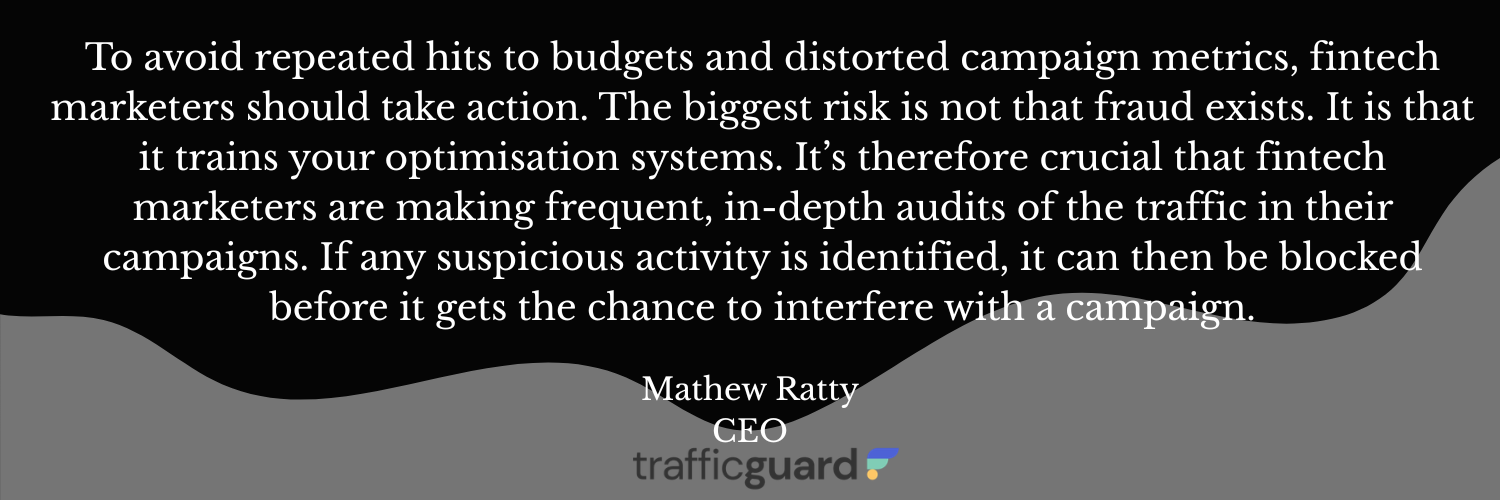
That insight matters because fintech organisations increasingly depend on machine-driven advertising. A polluted dataset does not merely affect current performance. It shapes future decisions, influences spending priorities, and alters growth trajectories across regions and product lines.
Recent industry analysis suggests that sophisticated bot networks increasingly leverage artificial intelligence to imitate authentic journeys. That development raises the cost of detection and reinforces the need for proactive controls. Organisations that rely heavily on automation face heightened exposure today.
What Should Fintech Leaders Do To Protect Growth?
Waiting for conversion declines often means the damage has already influenced bidding models and budget allocation. Industry leaders should focus on traffic audits, real-time validation, explainable exclusions, and continuous monitoring. Transparency also plays a critical role. Clear reporting helps advertisers identify suspicious activity before optimisation systems learn from unreliable inputs. It strengthens accountability between agencies, platforms, and internal stakeholders.
During rapid expansion, warning signs often include unstable acquisition costs, unexpected traffic spikes, unusual geographic activity, and declining engagement quality. Successful organisations respond quickly without restricting legitimate customer reach. Precision matters more than blanket blocking. Sustainable growth depends on protecting signal quality while maintaining acquisition momentum. The future battle against invalid traffic will centre on defending trustworthy data.
They recognise that campaign efficiency, forecasting accuracy, and customer acquisition economics are interconnected. Protecting data integrity supports stronger decision-making and creates a more resilient foundation for scale.
Which steps is your organisation taking today to ensure growth decisions are driven by evidence rather than noise?
Read full article at FinTec Buzz
Get started - it's free
You can set up a TrafficGuard account in minutes, so we’ll be protecting your campaigns before you can say ‘sky-high ROI’.
He is the Co Founder and current Chief Executive Officer of Adveritas and TrafficGuard since 2018. Prior to this Mr Ratty Co-founded MC Management Group Pty Ltd, a venture capital firm operating in domestic and international debt and equity markets, who are also substantial shareholders in the Company. At MC Management, Mr Ratty held the role of Head of Investment and was responsible for asset allocation.

Explore Other News
.png)
.png)
Subscribe
Subscribe now to get all the latest news and insights on digital advertising, machine learning and ad fraud.


