

The Advertiser’s Dilemma: Protecting ROI From AI-Powered Ad Fraud

AI-powered ad fraud uses generative AI to create bots that mimic your ideal customer, faking clicks, conversions, and engagement convincingly enough to fool standard ad-platform filters. To protect ROI, advertisers need independent, real-time verification that removes sophisticated invalid traffic before it corrupts the conversion data their bidding relies on. That means three things: invalidating bad traffic surgically so genuine users are never blocked, protecting every channel rather than one, and demanding full transparency on what is flagged and why.
AI-powered ad fraud has broken the simple promise digital advertising used to run on. For years you could define your audience, set your budget, and rely on algorithmic bidding to deliver real clicks and real return. That promise is now under pressure, and the question for every advertiser is the same: how do you verify performance and protect spend when the metrics of engagement can be faked well enough to fool the tools you rely on?
The Vanishing Reality of Digital Performance
Generative AI has handed bad actors an industrial-scale toolkit. The threat is no longer just crude click bots or domain spoofing. Advertisers now face automated fraud sophisticated enough to mimic the exact behaviour their algorithms optimise toward, and convincing enough to slip past non-sophisticated filters.
That changes the job. Verifying performance and protecting spend now means accounting for traffic that looks human but is not, across every channel you run.
How AI-Powered Ad Fraud Works
Generative AI has driven the cost of creating fake digital activity sharply down. It can rapidly generate fake websites, apps, and content, and orchestrate bots that mimic human interactions in real time, making it harder to distinguish genuine sources from fraudulent ones.
As TrafficGuard has documented, click farms can now be automated and orchestrated using generative AI that evolves where, when, and how scripted traffic is generated and how it behaves. The same tooling is being used to scrape sites and complete in-app actions that further complicate detection.
Across Search, Meta, Affiliate, and Mobile, the volume and sophistication of invalid traffic is climbing. Static lists and blunt rules cannot keep pace.
The ROI Mirage: Why Top-of-Funnel Metrics Break
Optimising purely on click-through rate, cost per click, or cost per lead is now a trap.
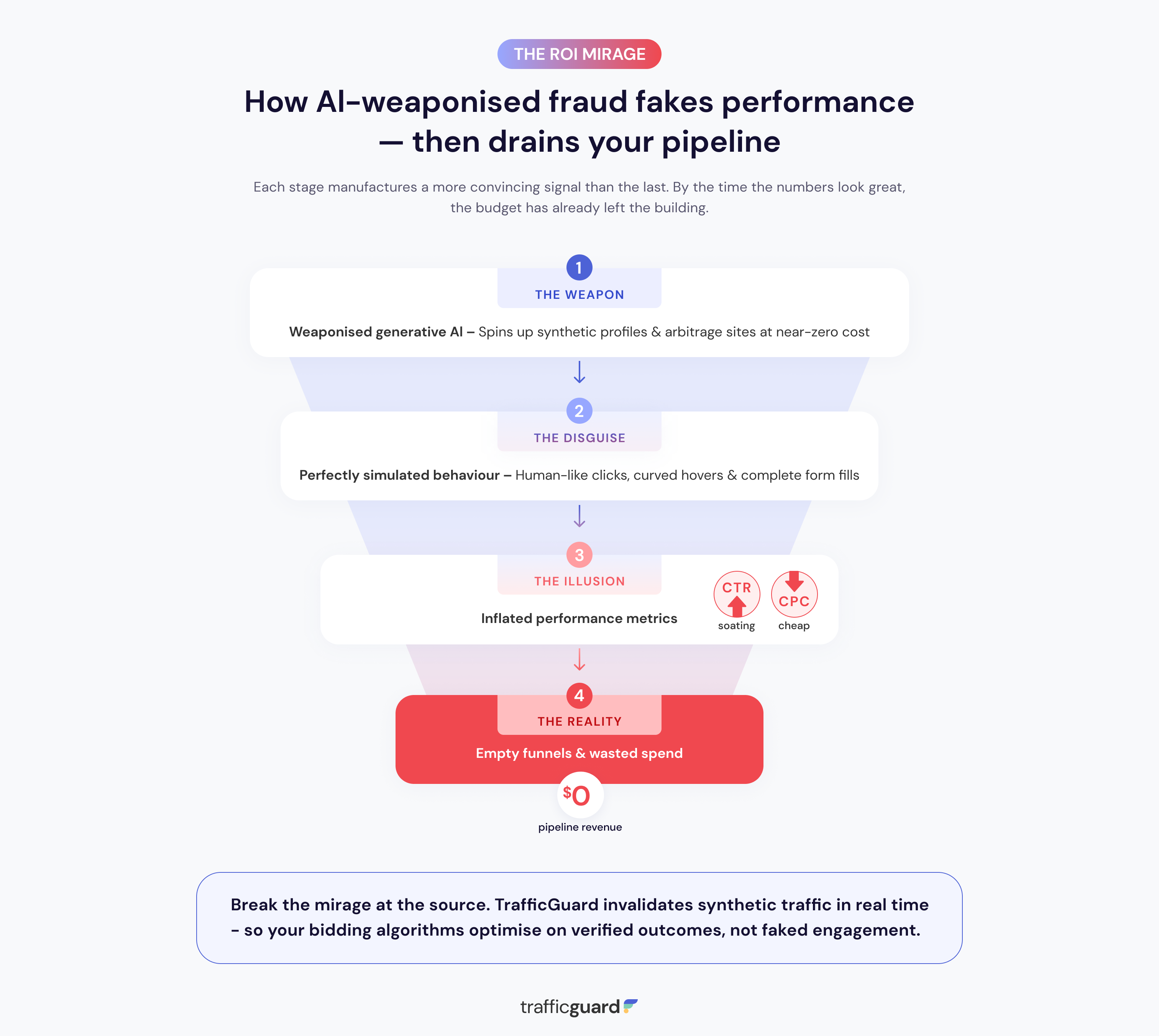
An AI-driven bot can be programmed to behave like your ideal customer. It browses your store, moves the mouse in curving motions with a jitter, hesitates over product images, adds items to a cart, and fills out lead forms with believable details.
When your campaigns optimise toward that behaviour, the bidding algorithm shifts budget toward the synthetic audience producing it. Dashboards show soaring engagement while your sales team chases dead-end leads and your pipeline stays dry. The deeper damage is to your data. Bot conversions pollute the signals Google and Meta use to optimise, training your bidding algorithms to prioritise the wrong users and pushing every future dollar in the wrong direction.
Here's an illustration show it works:
A Surgical Approach to Protecting Ad Spend
Surviving this landscape means moving from passive trust in ad networks to active, independent verification built into every campaign. TrafficGuard sits within the advertising journey to detect, mitigate, and report on invalid traffic in real time, before it impacts performance.
Three principles separate that approach from the blunt tools most advertisers still use.
1. Invalidate surgically, not bluntly
TrafficGuard uses AI-driven behavioural and statistical invalidation to remove bad traffic while protecting your genuine interactions, so campaigns keep reaching real people without damaging future performance.
2. Filter for non-incremental traffic, not just fraud
Not every wasted click is fraud. Some of it comes from real people, repeat clickers and navigational traffic that would have found your brand anyway. This isn’t fraud; it’s a paid-search efficiency problem, where a familiar user’s tenth click is charged at the same CPC as a new user’s first.
Alongside that, genuine fraud, the bot activity that pollutes conversion data, burns budget and corrupts optimisation. Engaging TrafficGuard to address both gives Search and Meta the clean signals they need to perform, and tackles the cookie stuffing, click injection, and misattribution draining Affiliate budgets.
3. Demand transparency by design
Every invalidation should come with visibility into what was flagged and why, across the funnel, so you can prove that spend reached real people and account for your advertising budget.
What to Look for and What to Do Next
Before you sign up for anything, four moves will tell you how exposed you are to sophisticated invalid traffic.
- Audit your vendors. Confirm your protection partner uses behavioural and statistical modelling rather than outdated exclusion lists, and that it reports transparently on what it filters.
- Protect the full funnel. Invalid traffic crosses Search, Meta, Affiliate, and Mobile. Point protection on one channel leaves the others exposed and your conversion data corrupted.
- Measure on verified outcomes across campaigns, not just within campaigns in isolation. Align optimisation with verified conversions, completed sales, post-login activity, and cohort lifetime value rather than top-of-funnel metrics.
- Protect your data. Conversion signals are what let Google and Meta optimise toward real customers. Keeping bots out of your conversion data compounds in your favour over time.
Frequently Asked Questions
What is AI-powered ad fraud?
AI-powered ad fraud is invalid traffic generated and orchestrated with generative AI. Rather than crude click bots or domain spoofing, it produces fake websites, apps, and content, and runs bots that mimic human interactions in real time, making fraudulent sources hard to distinguish from genuine ones.
How is it different from traditional click bots?
Traditional bots follow predictable, scripted patterns that static lists and rules can catch. AI-driven bots evolve where, when, and how they generate traffic, and they imitate the exact behaviour your algorithms optimise toward, browsing, hesitating, adding to cart, and completing forms convincingly enough to slip past non-sophisticated filters.
Why do metrics like CTR, CPC, and CPL fail against it?
Because those metrics measure activity, not authenticity. When bots are built to behave like your ideal customer, your bidding algorithm shifts budget toward the synthetic audience producing that activity. Engagement looks strong while the pipeline stays dry, and bot conversions pollute the data Google and Meta use to optimise.
How can advertisers protect ROI from AI-powered ad fraud?
Verify independently and in real time. Audit your protection vendor for behavioural and statistical modelling rather than exclusion lists, protect every channel rather than one, measure on verified outcomes across campaigns, and keep bots out of your conversion data so platforms optimise toward real customers.
Does AI-powered ad fraud only affect one channel?
No. Invalid traffic crosses Search, Meta, Affiliate, and Mobile. Protecting a single channel leaves the others exposed and your conversion data corrupted, which is why full-funnel protection matters.
The Bottom Line
AI-powered ad fraud no longer announces itself with crude bot patterns. It mimics your best customers, corrupts the data your bidding relies on, and quietly pushes budget toward an audience that will never convert. The advertisers who hold their ROI will be the ones who move from passive trust to active, independent verification across every channel.
Request a free paid search audit to see how much of your spend is reaching real people.
Get started - it's free
You can set up a TrafficGuard account in minutes, so we’ll be protecting your campaigns before you can say ‘sky-high ROI’.

Explore More Blogs


Subscribe
Subscribe now to get all the latest news and insights on digital advertising, machine learning and ad fraud.


