

ChatGPT Ads: The Invalid Traffic Risk Advertisers Need to Know
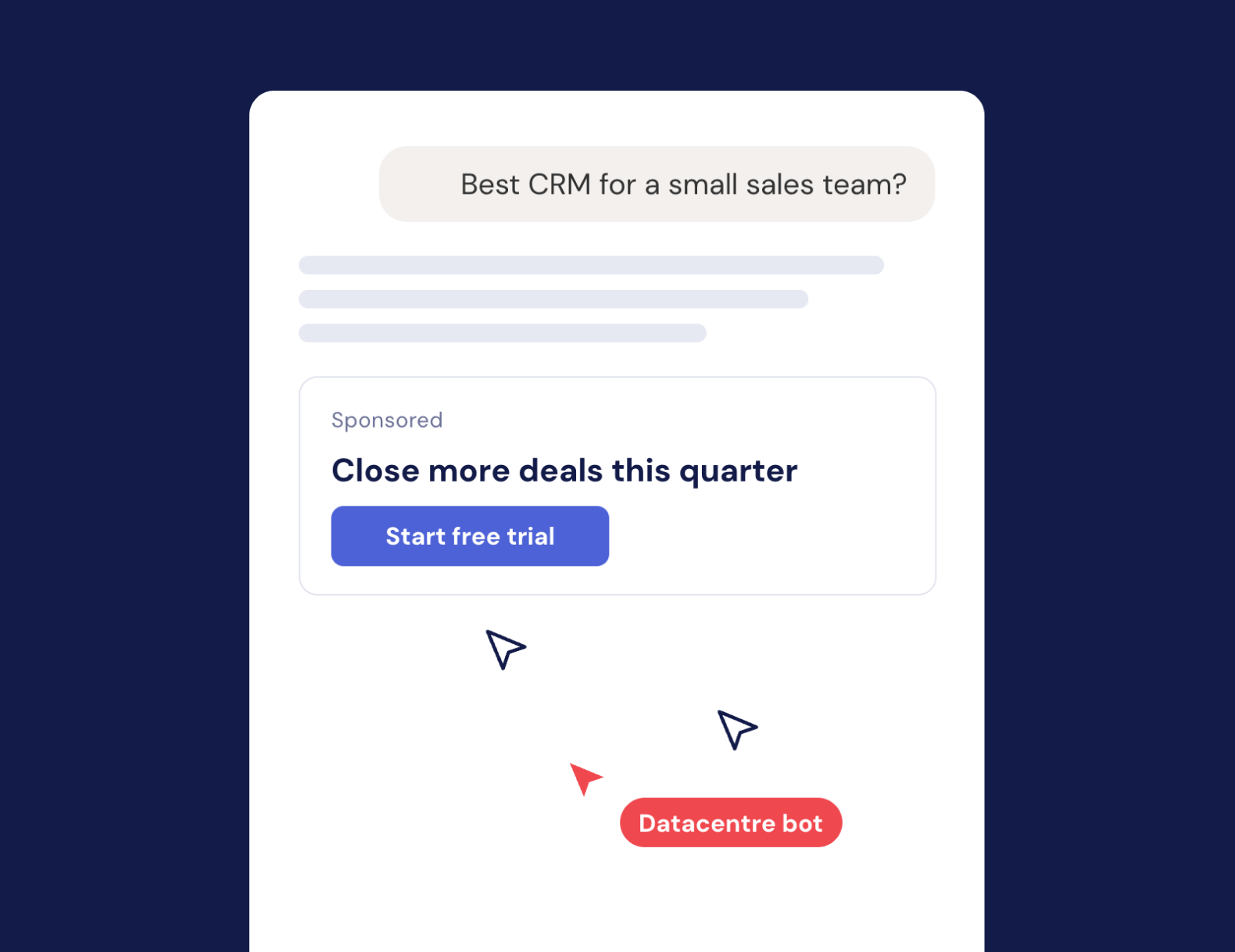
Invalid traffic is already affecting ChatGPT Ads. TrafficGuard analysed 40,021 ChatGPT ad clicks across 47 advertisers and found 1,592 invalid clicks, with invalid click rates ranging from 0.1% to 34% by advertiser. On the worst-affected campaigns, up to one in three clicks came from sources that could never convert. Nearly half of all invalid clicks identified came from just four hosting and proxy networks, while ChatGPT ad clicks originated from hosting, proxy and malicious IP infrastructure at 3.6 times the rate of the same advertisers’ Google Ads traffic. For advertisers testing ChatGPT Ads, the risk is not only wasted spend: invalid traffic can also distort conversion data, bidding signals and early decisions about whether to scale the channel.
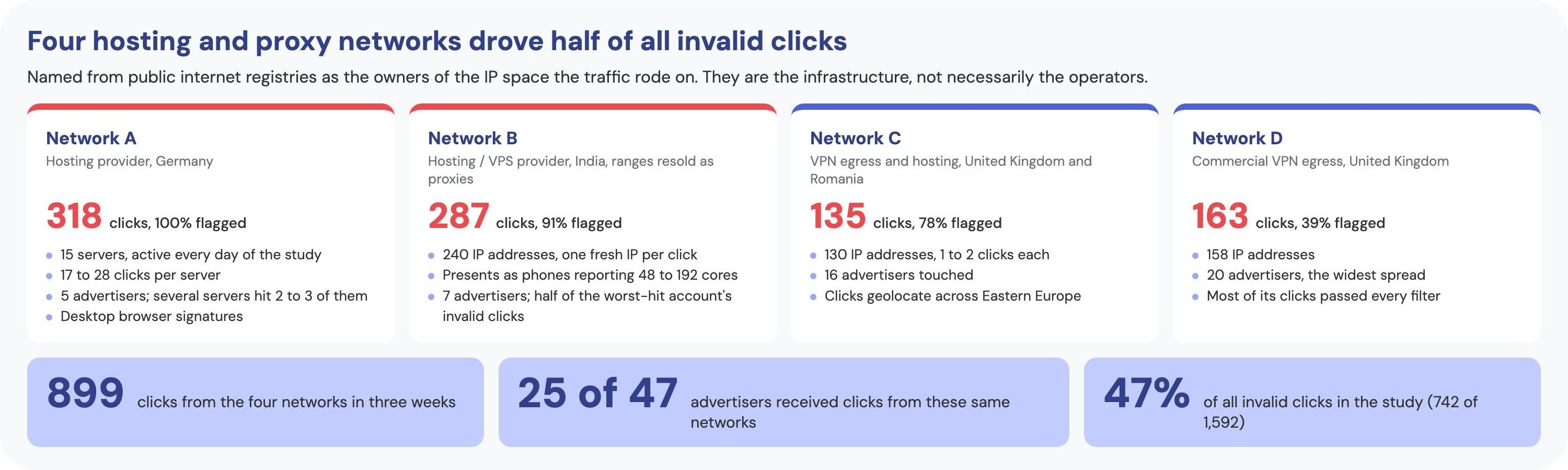
ChatGPT ads opened to advertisers in April. By late August, 15 servers at a single hosting provider in Germany were clicking ads from five advertisers every day. Over three weeks they clicked 318 times, and every one of those clicks was flagged as invalid.
That pattern is one of the clearest findings from TrafficGuard's analysis of 47 advertisers running paid campaigns in ChatGPT. Invalid click rates ranged from 0.1% to 34% by advertiser. On the worst-affected campaigns, up to one in three clicks could never become a customer.
The channel is new, but the traffic problem is not. Here is what we found, why a new channel is more exposed, and what to check in your account this week.
What We Found in ChatGPT Ad Traffic
Between 24 August and 14 September 2026, we analysed 40,021 ChatGPT ad clicks landing on 78 websites of 47 advertisers. We compared them with 5.6 million clicks on the same advertisers' Google Ads campaigns over the same period, classified by the same rules. Most of the invalid traffic came from a small number of coordinated sources on hosting and proxy infrastructure, not from scattered bots.
The level of invalid traffic varied widely between advertisers. Two advertisers running ChatGPT Ads at the same time could see very different levels of exposure, and standard platform reporting may not make that difference obvious.
Set against the same advertisers' Google Ads traffic, two signals stood out. The first was where the clicks came from: ChatGPT ad clicks arrived from hosting, proxy and malicious IP space at 3.6 times the Google Ads rate.
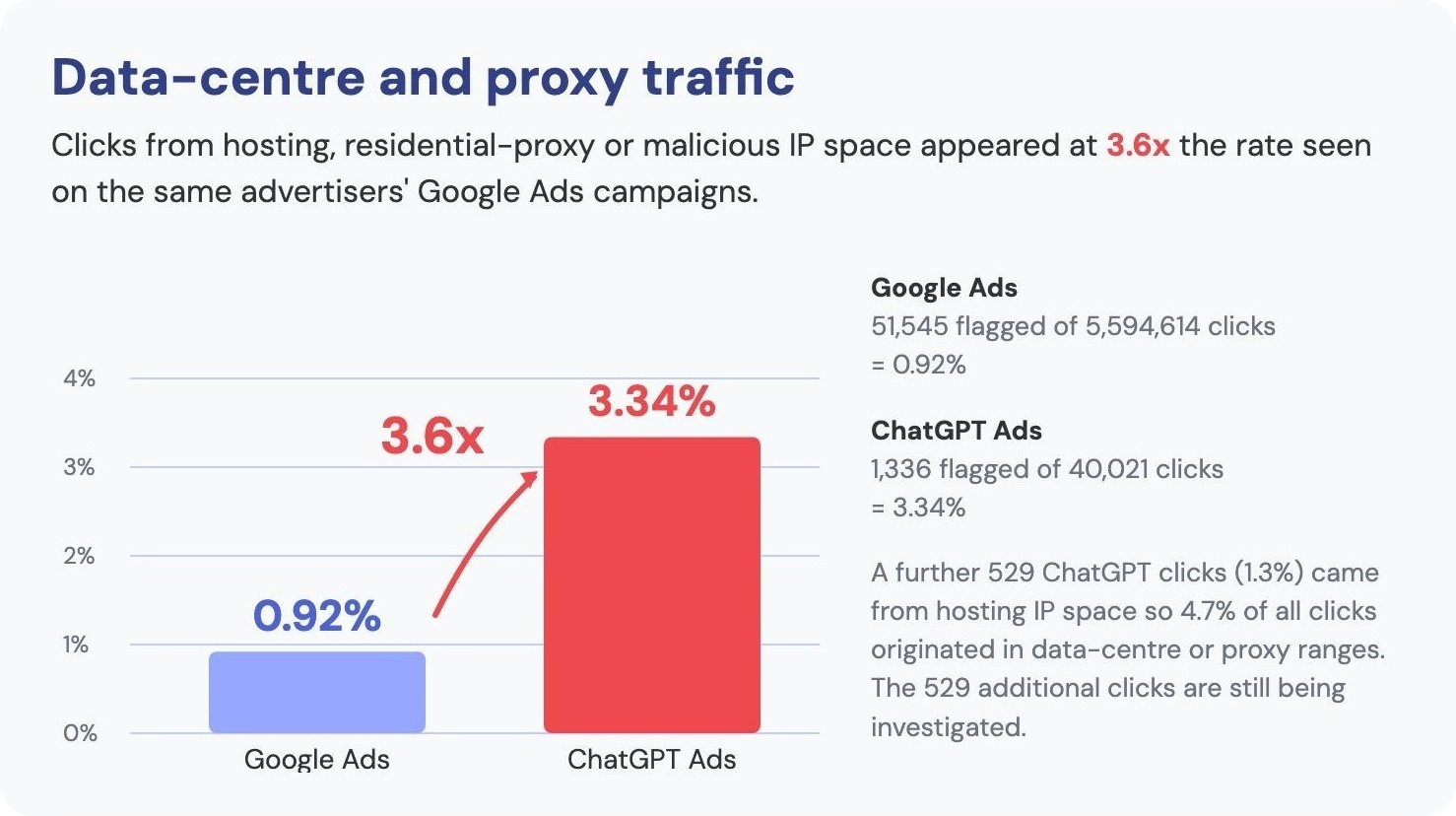
Because we compared ChatGPT Ads with Google Ads traffic from the same advertisers, differences in brand, offer or landing page do not explain the gap. The difference was where the traffic came from.
The second signal was the devices. Clicks from devices with hardware configurations that could not exist appeared at nine times the rate seen in Google Ads.
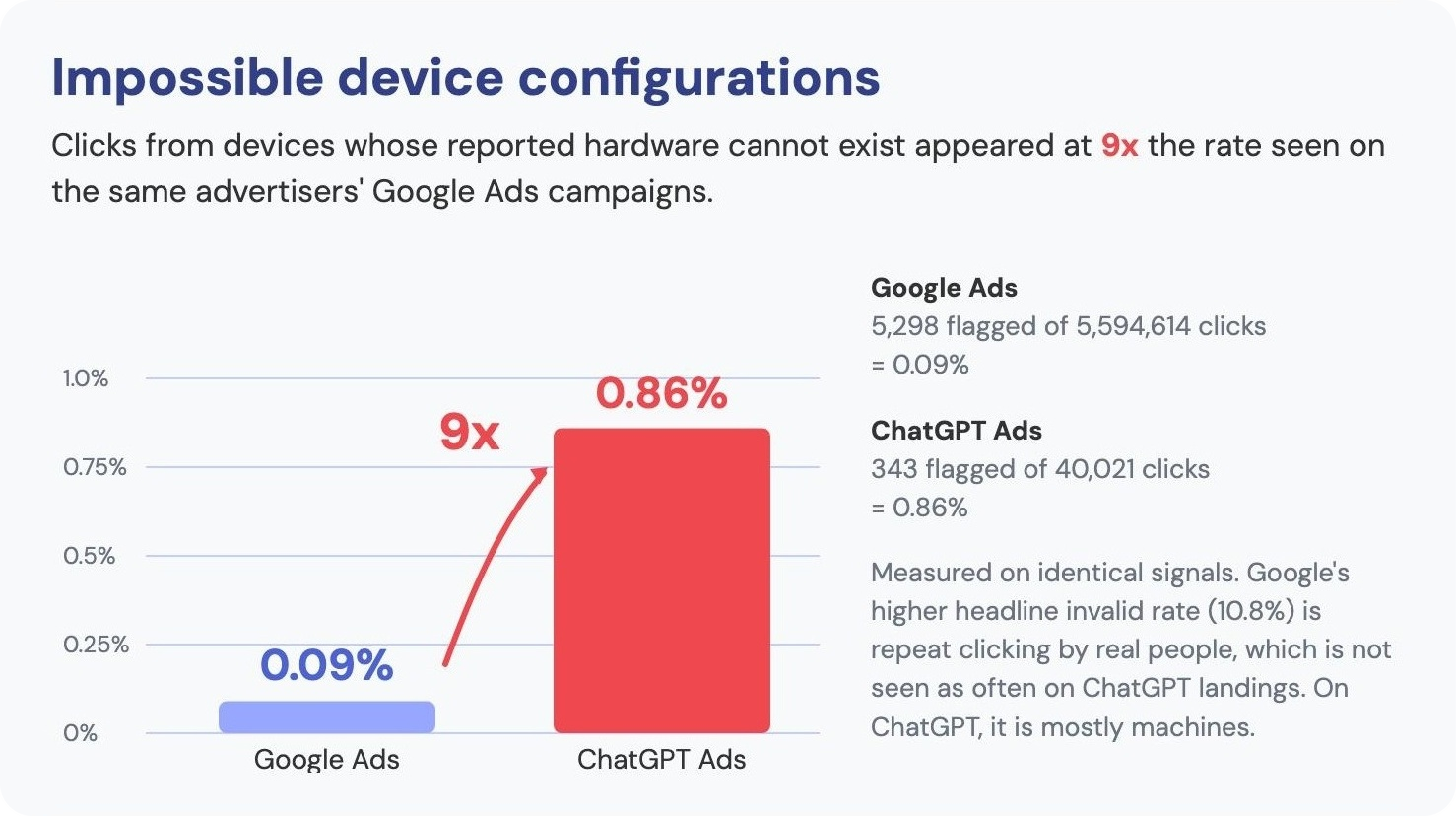
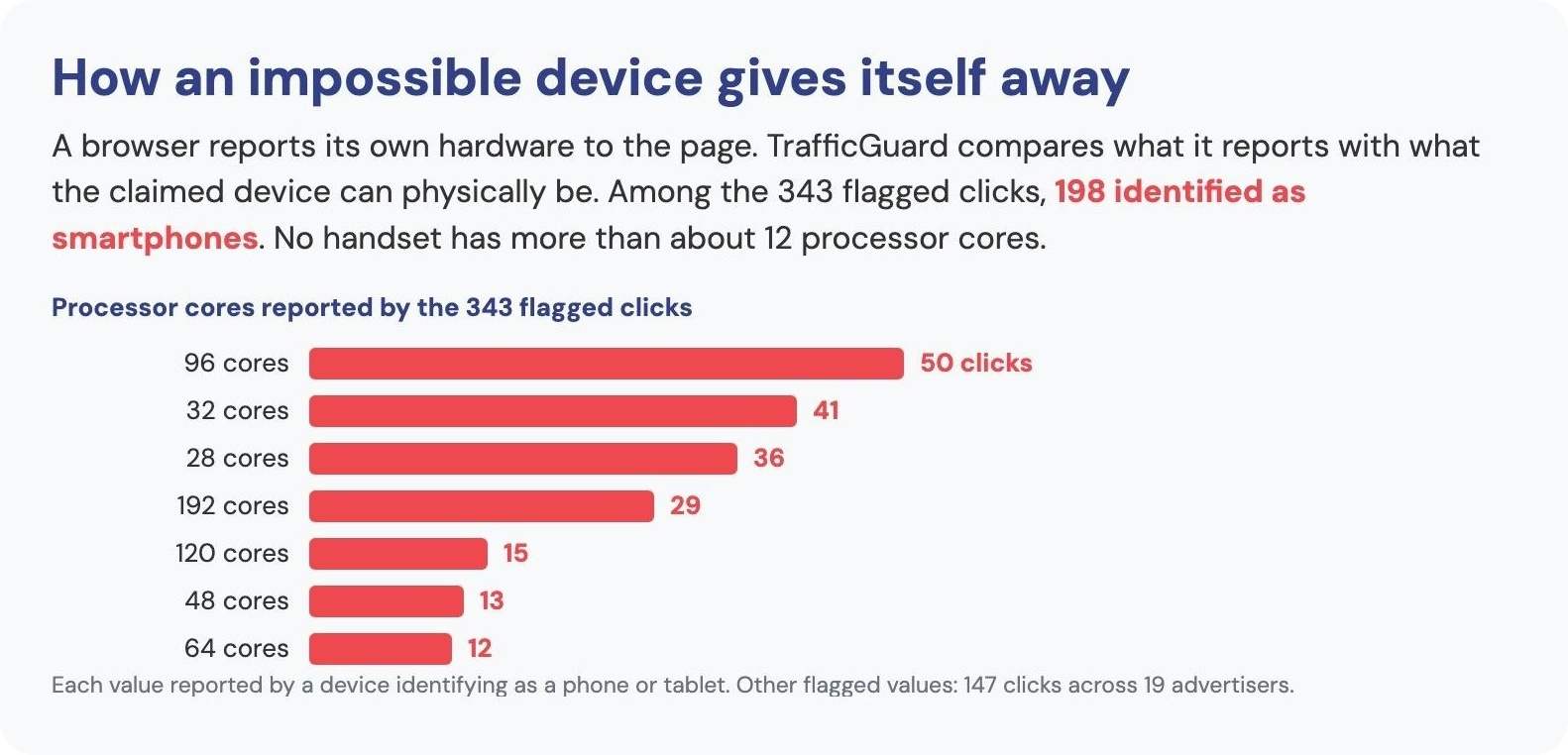
The device data made some invalid clicks easy to identify. Browsers report hardware information, which can be checked against the device they claim to be using.
Of the 343 clicks flagged for impossible hardware, 198 claimed to come from smartphones reporting 28, 96 or even 192 processor cores. No real smartphone comes close.
The invalid traffic was highly concentrated. Just four hosting and proxy networks sent 899 clicks in three weeks, reached 25 of the 47 advertisers and accounted for 742 of the 1,592 invalid clicks, or 47%.
One network alone was responsible for half of the invalid clicks in the worst-affected account. Another, a commercial VPN, sent traffic that passed most filters.
These networks provided the infrastructure the traffic came from, but they were not necessarily responsible for generating the clicks.
Why Invalid Traffic Appears Early in New Ad Channels
New channels attract new budgets, and invalid traffic follows the budget. ChatGPT Ads has expanded quickly since April, adding features such as conversion optimisation, geographic targeting and custom audiences.
Advertisers have almost no historical data to compare against. There is no established benchmark yet for click-through rate, conversion lag, geography or device mix.
That makes unusual traffic harder to recognise. A campaign taking a large share of its clicks from datacentres can look like a normal early test when there is nothing to compare it with.
"OpenAI is not uniquely vulnerable, it is simply the newest place to sell clicks, and low-quality traffic follows the budget wherever it goes." Miguel Lopes, Chief Product Officer, TrafficGuard
Invalid traffic already affects Search, social and affiliate channels. The difference is how quickly the same patterns have appeared in a new advertising channel.
Why Invalid Traffic Costs More Than Wasted Clicks
The direct cost is easy to see. A campaign spending $20,000 a month with a 34% invalid click rate would spend roughly $6,800 on traffic that has no chance of converting. As our CEO Mathew Ratty put it, "Every dollar spent on a click that can never convert is a dollar taken from a real customer."
The bigger risk is what invalid traffic does to campaign decisions. ChatGPT Ads uses conversion-optimised bidding to help steer delivery towards clicks that are more likely to convert. If a large share of the clicks is invalid, the bidding learns from the wrong signals.
It also distorts reporting. A test campaign with a low conversion rate may look like proof that the channel is not working, when part of the problem is the traffic. That can lead teams to cut a promising channel too early, or scale it based on misleading results.
"It is coordinated, it is persistent and it is clicking every day. Most advertisers have no idea how much of their spend is going to it." Mathew Ratty, CEO and co-founder, TrafficGuard
Six Ways to Check ChatGPT Ads for Invalid Traffic
You can run most of these checks with data already in your analytics or server logs.
- Separate ChatGPT Ads from your other paid traffic. Compare ChatGPT performance with Search campaigns promoting the same offer. Large differences in behaviour can be an early warning sign.
- Check where clicks come from. Look for traffic from datacentres, hosting providers and proxy networks. A high share from these sources deserves closer investigation.
- Look for repeated patterns. The same IP ranges or device configurations appearing day after day, or across multiple campaigns, can indicate coordinated traffic.
- Check for impossible devices. A smartphone reporting 96 processor cores, or an unrealistic combination of browser, operating system and screen size, can be a clear sign of automation.
- Compare clicks with real visits. Match paid clicks against landing page sessions, engagement and other on-site activity. Investigate any click that never turns into a meaningful visit.
- Use qualified conversion signals. Optimise towards meaningful actions such as sign-ups, purchases or booked calls rather than simple page views. Exclude locations you do not serve where appropriate.
Check traffic quality before increasing spend. A problem is far cheaper to find while the test is small than after the budget has scaled.
Where TrafficGuard fits
ChatGPT is the newest place invalid traffic has turned up, not the only one. The signals we found there (datacentre and proxy infrastructure, sources that return every day, devices that cannot exist) show up across every major paid channel. ChatGPT simply showed them at a higher rate than the same advertisers' Search campaigns.
TrafficGuard protects Search, Meta and Affiliate campaigns by identifying invalid traffic in real time, not weeks later in a report, so you stop paying for clicks from sources that can never convert.
We invalidate traffic statistically rather than blocking whole audiences or regions, so real customers stay in your campaigns and your bidding learns from people who can actually buy. If you are moving budget into ChatGPT tests, clean core channels also give you a reliable baseline to judge the new channel against.
If you want to understand how much invalid traffic is affecting your paid media, book a demo and we can show you what is happening in your own campaign data.
Frequently asked questions
What are ChatGPT Ads and how do they work?
ChatGPT Ads are paid placements that appear within the ChatGPT experience. Rather than relying only on traditional keyword targeting, ad delivery considers factors such as the context and intent of the conversation, the advertiser’s landing page, ad copy and context hints. Advertisers can currently run campaigns focused on views, clicks or conversions.
How much do ChatGPT Ads cost?
ChatGPT Ads supports CPM and CPC buying, as well as conversion-optimised campaigns. For click campaigns, advertisers set a maximum CPC bid and pay for valid clicks. OpenAI currently recommends starting CPC bids of around $3 to $5, although actual costs and performance vary by campaign, audience and competition.
How does targeting work in ChatGPT Ads?
ChatGPT Ads does not work like traditional keyword targeting. Advertisers can provide context hints describing their product, who it is relevant to and the situations in which it may be useful. ChatGPT then uses these signals alongside the context and intent of the conversation to determine when an ad may be relevant. Context hints guide relevance rather than acting as exact-match keywords.
Can you track conversions from ChatGPT Ads?
Yes. ChatGPT Ads Manager includes reporting for metrics such as impressions, clicks, spend, CTR, CPC and conversions. Advertisers can also set up conversion measurement and use tracking parameters such as UTMs to analyse ChatGPT traffic in their existing analytics tools.
Is there invalid traffic in ChatGPT Ads?
Yes. TrafficGuard analysed 40,021 ChatGPT ad clicks across 47 advertisers between 24 August and 14 September 2026 and identified 1,592 invalid clicks. Invalid click rates ranged from 0.1% to 34% by advertiser, meaning that on the worst-affected campaigns up to one in three clicks came from sources that could never convert.
Where does invalid traffic in ChatGPT Ads come from?
In our analysis, much of the invalid traffic was concentrated among a small number of coordinated sources using hosting and proxy infrastructure. Four hosting and proxy networks reached 25 of the 47 advertisers and accounted for 47% of all invalid clicks. These networks provided the infrastructure the traffic came from, but they were not necessarily responsible for generating the clicks.
Is ChatGPT Ads traffic more likely to be invalid than Google Ads traffic?
In TrafficGuard's analysis of the same advertisers over the same period, ChatGPT ad clicks came from hosting, proxy and malicious IP infrastructure at 3.6 times the rate of their Google Ads traffic. Impossible device configurations also appeared at nine times the Google Ads rate. This does not mean ChatGPT Ads is inherently unsafe, but it shows why advertisers should measure traffic quality when testing the channel.
How can I check ChatGPT Ads for invalid traffic?
Start by reporting ChatGPT Ads separately from other paid channels. Check for clicks from datacentres, hosting providers and proxy networks, repeated IP or device patterns, unrealistic device configurations and paid clicks that do not correspond with meaningful website activity. Comparing ChatGPT Ads with Search campaigns promoting the same offer can also help establish a baseline.
Are ChatGPT Ads worth testing?
Potentially, but advertisers should treat the channel as a test rather than assume it will perform like Google Search or paid social. OpenAI says there are not yet established performance benchmarks across advertisers, industries or campaign types. Measure conversions, traffic quality and the quality of the customers generated before increasing spend.
Get started - it's free
You can set up a TrafficGuard account in minutes, so we’ll be protecting your campaigns before you can say ‘sky-high ROI’.

Explore More Blogs


Subscribe
Subscribe now to get all the latest news and insights on digital advertising, machine learning and ad fraud.


