

E-commerce Holiday Ad Fraud 2026: Protect Your Ad Spend from the $250B Threat

Every year, fraudsters treat the holiday season as an open window. Ad spend surges, campaigns scale fast, and the pressure to hit targets overrides scrutiny. The result is predictable: billions in budget hijacked by bots, fake clicks, and sophisticated invalid traffic before a single genuine consumer sees your ad.
In 2026, the threat has evolved. AI-generated fraud, deepfake creative, and adversarial bot networks have reset the baseline for what click fraud protection needs to look like. This blog breaks down what you are up against, where fraud concentrates, and what proactive measures actually work.
The State of Ad Fraud in 2026: Key Numbers Every E-commerce Brand Must Know
The scale of the problem is not abstract. It is measurable, growing, and hitting e-commerce advertisers hardest during the periods when budgets are at their peak.
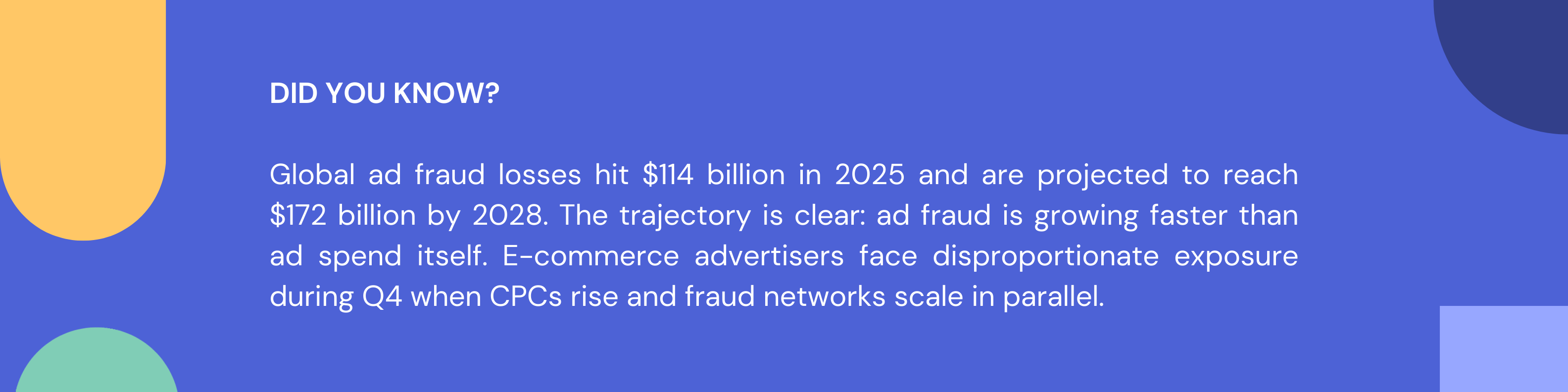
Key figures shaping the 2026 landscape:
- Bots account for 57% of eCommerce website traffic during the holiday season, significantly increasing the risk of wasted ad spend during peak shopping periods.
- Affiliate fraud now accounts for over 30% of reported ad fraud cases, driven by commission-hungry bad actors exploiting last-click attribution windows.
- Mobile ad fraud has surpassed desktop as the primary attack surface, with fraudulent in-app traffic representing the fastest-growing IVT category.
- Sophisticated invalid traffic (SIVT), the hardest category to detect, now makes up the majority of total IVT volume globally.
What this means for e-commerce brands is direct: a meaningful share of your Black Friday, Singles' Day, or Diwali budget will never reach a real person unless you have active fraud prevention in place. The spend is not wasted on poor creative or weak targeting. It was stolen.
How AI and Deepfakes Are Supercharging Holiday Ad Fraud
The fraud landscape of 2026 is not a scaled-up version of what existed three years ago. It is categorically different. AI has fundamentally changed what fraud looks like, how it operates, and how difficult it is to detect without purpose-built tooling.
AI-generated bots that mimic real shoppers
Modern fraud bots do not behave like bots. They replicate human browsing patterns: variable session times, realistic scroll depth, mouse movement, and interaction sequences calibrated to evade standard detection logic. Trained on real user behaviour data, these bots can pass basic traffic quality filters with ease.

During the holiday season, when traffic spikes are expected and attribution windows are compressed, AI-generated bots cause significant damage before anomalies are even flagged. By the time a reactive review occurs, budget has been depleted.
Deepfake ads and synthetic influencers
A newer and fast-growing fraud vector involves synthetic creative: deepfake video ads and AI-generated influencer endorsements that appear legitimate to platforms and consumers alike. Fraudsters use these to drive traffic from real users to counterfeit storefronts, inflating click-through data while generating zero genuine revenue.
For e-commerce brands, the risk is double-sided. Your ads may run alongside synthetic content that damages brand trust, and your budget may be allocated to ad placements that were never legitimate to begin with.
The rise of sophisticated invalid traffic (SIVT)
SIVT is defined by the Media Rating Council as traffic that requires advanced analytics to detect and cannot be screened by basic filtering. It includes adware-generated traffic, hijacked devices, and incentivised engagement networks designed to simulate genuine consumer intent.
SIVT is the category that causes the most material budget loss for e-commerce advertisers. Unlike general invalid traffic, it can persist undetected for entire campaign cycles unless you have real-time pre-bid detection in place. Understanding and blocking SIVT is a core function of any credible e-commerce fraud protection strategy.
Holiday E-commerce Sales 2025-2026: A Record-Breaking Target for Fraudsters
Adobe Analytics data showed that the 2025 holiday season set new records across every major e-commerce market. US consumers alone spent over $240 billion online between November and January, with mobile commerce accounting for more than 55% of total transactions. US holiday e-commerce spend hit $240B+ in 2025, with mobile representing 55% of transactions. Global holiday e-commerce surpassed $1.2 trillion for the first time. Every dollar of that spend was a target for ad fraud.
For advertisers, record sales figures mean one thing operationally: higher CPCs, compressed decision windows, and increased competition for placements. Fraud thrives in precisely this environment. When demand is high and oversight is thin, fraudulent traffic sources scale because the economics justify the risk.
The brands that captured genuine return on ad spend during 2025 were not necessarily those with the biggest budgets. They were the ones with clean traffic. Fraud prevention is not a line item to justify. It is a prerequisite for performance.
Regional Spotlight: Ad Fraud Hotspots in APAC, GCC, and Beyond
Ad fraud is not evenly distributed. Certain regions carry disproportionately high IVT rates, and e-commerce advertisers targeting these markets without regional controls face elevated exposure.
Asia-Pacific (APAC): APAC remains the highest-risk region globally. Fraudlogix 2025 data estimates that advertisers in Southeast Asia face IVT rates of up to 40% on open exchange programmatic inventory. The combination of high mobile penetration, rapid e-commerce growth, and fragmented ad tech infrastructure creates conditions that fraud networks actively exploit. Regional shopping events including Singles' Day (11.11), Harbolnas in Indonesia, and 12.12 sales represent particularly high-risk windows.
Gulf Cooperation Council (GCC): The GCC has emerged as a fast-growing ad fraud hotspot as digital ad investment has scaled sharply across Saudi Arabia, UAE, and Qatar. Fraud infrastructure in the region is increasingly sophisticated, with affiliate fraud and fake influencer traffic representing the dominant attack vectors during Ramadan and National Day promotional periods.
Europe and North America:
More mature fraud prevention ecosystems exist in these markets, but SIVT exposure during Black Friday and Cyber Monday remains significant. PMax campaigns and social media retargeting are the primary channels where budget leakage occurs.
For e-commerce brands operating across multiple markets simultaneously, a single global fraud prevention layer is insufficient. Regional signal calibration is essential for accurate IVT detection without suppressing legitimate traffic.
Performance Max, Social Ads and Affiliate Fraud: Channel-by-Channel Risks
Fraud does not operate the same way across every ad channel. Understanding the specific risk profile of each channel you run is foundational to building an effective prevention strategy.
Google Performance Max (PMax): PMax consolidates inventory across Search, Display, YouTube, Gmail, and Discover into a single automated campaign. The opacity of channel-level reporting creates a structural vulnerability: fraudulent traffic can inflate conversion signals across the network without triggering standard anomaly detection. When PMax algorithms optimise toward invalid conversions, budget compounds in the wrong direction. Third-party auditing is not optional for PMax. It is the only way to see what the dashboard does not show you.
Paid social (Meta, TikTok, Snapchat): Social platforms self-report engagement metrics, creating an inherent conflict of interest. Click farms, incentivised traffic, and bot-driven engagement inflate reach figures without delivering genuine consumer intent. During the holiday season, social ad costs spike and fraud operators scale accordingly. Bot-driven engagement on paid social is particularly difficult to detect using platform-native tools alone.
Affiliate and partner marketing: Affiliate fraud has become the most financially damaging fraud type for e-commerce advertisers in terms of direct revenue impact. Commission structures incentivise bad actors to generate fake conversions, stuffed cookies, and click injection events. The issue is structural: affiliate networks have limited motivation to proactively remove high-volume fraudulent publishers.
Programmatic display and open exchange: Open exchange inventory consistently carries the highest raw IVT rates. Domain spoofing, ad stacking, and pixel stuffing are common techniques. Holiday season CPM inflation makes premium inventory more attractive to fraudsters who spoof high-quality placements to extract premium pricing on worthless impressions.
5 Proactive Strategies to Combat Ad Fraud This Holiday Season
The shift from reactive to proactive ad fraud management is the single most impactful operational change an e-commerce advertiser can make. Reactive approaches, reviewing anomalies post-spend or applying blacklists after campaigns have run, protect future budgets at best. Proactive prevention protects the budget you are deploying right now.
1. Real-Time IVT Detection and Pre-Bid Filtering
Pre-bid filtering stops fraudulent impressions from being purchased in the first place. Rather than analysing traffic after spend has occurred, pre-bid tools evaluate each impression opportunity in real time and block invalid sources before a bid is placed.
During the holiday season, when impression volume scales by multiples, pre-bid filtering delivers compounding value. Every fraudulent impression blocked is budget preserved for genuine reach. At scale, this translates directly to improved ROAS without changing creative, targeting, or bids.
2. Third-Party Auditing for PMax Campaigns
Google's Performance Max does not provide channel-level attribution transparency by default. TrafficGuard’s Pmax solution surfaces where within the PMax network your budget is actually converting, identifies invalid traffic sources that are influencing algorithm optimisation, and provides the signal clarity needed to make informed budget decisions.
Without third-party auditing, PMax campaigns during the holiday season operate as a black box. Brands assume performance signals are clean. Often, they are not.
3. Behavioural Analytics and Anomaly Detection
Machine learning-driven behavioural analytics identify fraud patterns that rule-based detection misses. By establishing a baseline of genuine user behaviour for your specific audience and traffic sources, anomaly detection flags deviations that indicate IVT, including the AI-generated bots designed to mimic real shoppers discussed earlier in this article.
Behavioural analytics become particularly valuable when combined with pre-bid filtering, providing a layered defence that addresses both known fraud signatures and emerging attack patterns in real time.
4. Affiliate Monitoring and Real-Time Publisher Scoring
Affiliate fraud is structural, which means detection needs to be continuous rather than periodic. Real-time publisher scoring evaluates affiliate traffic quality at the publisher level on an ongoing basis, flagging anomalous conversion rates, cookie stuffing patterns, and click injection sequences before commissions are paid on fraudulent activity.
The value of publisher-level scoring is that it shifts the economics of affiliate fraud against the bad actor. When fraudulent publishers know they will be flagged and removed before payout, the incentive structure changes. For e-commerce brands running large affiliate programmes during the holiday season, this is the difference between paying commissions on genuine revenue and subsidising fraud.
5. Cross-Channel Attribution Validation
Cross-channel attribution validation ensures that conversion signals across PMax, paid social, and affiliate channels are reconciled against independently verified traffic data. Where attribution signals diverge from verified engagement, the discrepancy is flagged for review before budget allocation decisions are made for subsequent campaign cycles.
This is the strategy that ties the other four together. Clean attribution data feeds better media mix models, which produce better budget decisions, which compound into better performance over every campaign cycle. In an environment where AI-generated fraud is actively corrupting conversion signals, validated attribution is the foundation of accurate ROAS measurement.
Why A Layered Approach To Ad Fraud Prevention Matters
The five strategies above work best as a layered defence. No single tactic is sufficient on its own.
Pre-bid filtering blocks known threats before spend occurs. Behavioural analytics identifies emerging fraud patterns. Publisher scoring addresses structural risks within affiliate programmes. TrafficGuard for Performance Max adds transparency where platform reporting is limited. Attribution validation ensures the data guiding your budget decisions remains accurate.
Preparing for 2026 and Beyond: Building Long-Term Ad Fraud Resilience
The holiday season is the highest-stakes window, but ad fraud operates year-round. The brands that outperform on ROAS consistently are those that treat fraud prevention as a permanent operational layer rather than a seasonal activation.
Three structural shifts define long-term ad fraud resilience:
Move from detection to prevention. Detection tells you what went wrong after the fact. Prevention stops fraud before it costs you. The infrastructure investment is comparable. The commercial outcome is substantially different.
Demand transparency at every layer. Whether you are running PMax, programmatic display, or a partner affiliate programme, independent verification of traffic quality should be a contractual standard, not an optional audit. Platforms that cannot provide verified traffic data are not partners in your growth.
Integrate fraud prevention into your attribution model. Fraud prevention data should feed directly into your attribution and media mix modelling. Clean traffic signals produce more accurate models, which produce better budget decisions. The downstream value of verified attribution compounds over every campaign cycle.
The competitive advantage in e-commerce advertising is no longer just about who spends the most or who has the best creative. It is about who has the cleanest signal. In a market where ad fraud losses exceed $250 billion annually and AI is actively supercharging the sophistication of attacks, the brands that win are the ones that protect the integrity of their data.
TrafficGuard gives performance marketers the tools to detect, block, and recover from ad fraud in real time, across every channel, in every market. The holiday season is too valuable to hand any of it to fraudsters.
Ready to protect your ad spend? Talk to TrafficGuard.
FAQs & Key Takeaways
1. How do I know if my campaigns are already affected by ad fraud?
Most advertisers do not find out until they audit. Signs include abnormally high CTRs with low conversion rates, traffic spikes from unfamiliar geographies, and inflated impression counts that do not translate to revenue. A third-party IVT audit will surface what your platform dashboards will not.
2. What is the difference between GIVT and SIVT, and why does it matter for my budget?
General invalid traffic (GIVT) is relatively easy to detect and filter. Sophisticated invalid traffic (SIVT) requires advanced analytics and is far more damaging precisely because it goes undetected longer. Most budget loss comes from SIVT, not GIVT.
3. Does Google's built-in fraud protection cover Performance Max campaigns?
Google applies some native filtering, but it does not provide channel-level transparency within PMax, meaning fraudulent conversion signals can influence how the algorithm allocates your budget without you knowing. Independent third-party auditing is the only way to verify what is actually happening inside PMax.
4. How does ad fraud specifically affect ROAS calculations?
Fraud inflates impression, click, and conversion data, which corrupts your ROAS figure upward. You appear to be performing better than you are. When decisions about scaling budgets are based on fraudulent signals, you compound the loss.
5. Is ad fraud worse during Black Friday and Cyber Monday than the rest of the year?
Yes. Fraud networks deliberately scale during peak spend periods because the economics favour it. Higher CPCs, larger budgets, compressed campaign windows, and reduced oversight create ideal conditions for fraudulent traffic to go undetected.
6. What should I look for in an ad fraud prevention solution?
Pre-bid filtering, real-time IVT detection, cross-channel coverage (including PMax and affiliate), transparent reporting, and independent verification that does not rely on platform-reported data. Any solution that only reviews traffic post-spend is already too late.
7. How does affiliate fraud differ from click fraud, and do I need separate protection?
Click fraud targets paid search and display spend. Affiliate fraud targets your commission model, generating fake conversions, stuffed cookies, and click injection events to trigger payouts. Both require protection, but the detection methods and data signals differ significantly.
8. Can small and mid-sized e-commerce brands afford ad fraud protection, or is it only for enterprise? The cost of fraud prevention is consistently lower than the cost of fraud itself. Brands losing even 10% of a $50,000 monthly ad budget to IVT are losing $5,000 per month. Purpose-built solutions like TrafficGuard are built to scale with budget size, not against it.
Get started - it's free
You can set up a TrafficGuard account in minutes, so we’ll be protecting your campaigns before you can say ‘sky-high ROI’.

Explore More Blogs


Subscribe
Subscribe now to get all the latest news and insights on digital advertising, machine learning and ad fraud.


