

What Affiliate Managers Actually See When They Look Beyond Last-Click Attribution
Most affiliate programmes are measured the same way: a conversion happens, credit gets assigned, and the last click wins. It’s a simple model, widely accepted, and easy to explain to stakeholders. But as programmes scale, the cracks start to show. Last-click attribution can tell you who got credit. It can’t tell you whether that credit was deserved.
That’s where affiliate fraud protection and journey-level validation become relevant. Not just to catch bad actors, but to understand whether affiliate conversions are genuinely incremental and correctly attributed in the first place.
This blog walks through what actually becomes visible when affiliate managers stop reviewing partner reports and start reviewing the full conversion journey.
The Last Click Feels Final. It Rarely Is.
Most affiliate managers live inside the affiliate platform. You review partner volumes, approve payouts, and flag anything that looks out of place. It’s a workflow that makes complete sense given how attribution is structured, because payout accuracy lives inside that platform.
The problem is that affiliate fraud doesn’t start with partners. It starts with conversions. When you begin a review with completed outcomes and work backwards through the journey, rather than forwards from a partner report, affiliate performance starts to look very different.
What The Affiliate Dashboard Actually Shows
Before getting into specific examples, it helps to understand how journey-level validation is structured. A typical affiliate review moves through three layers.
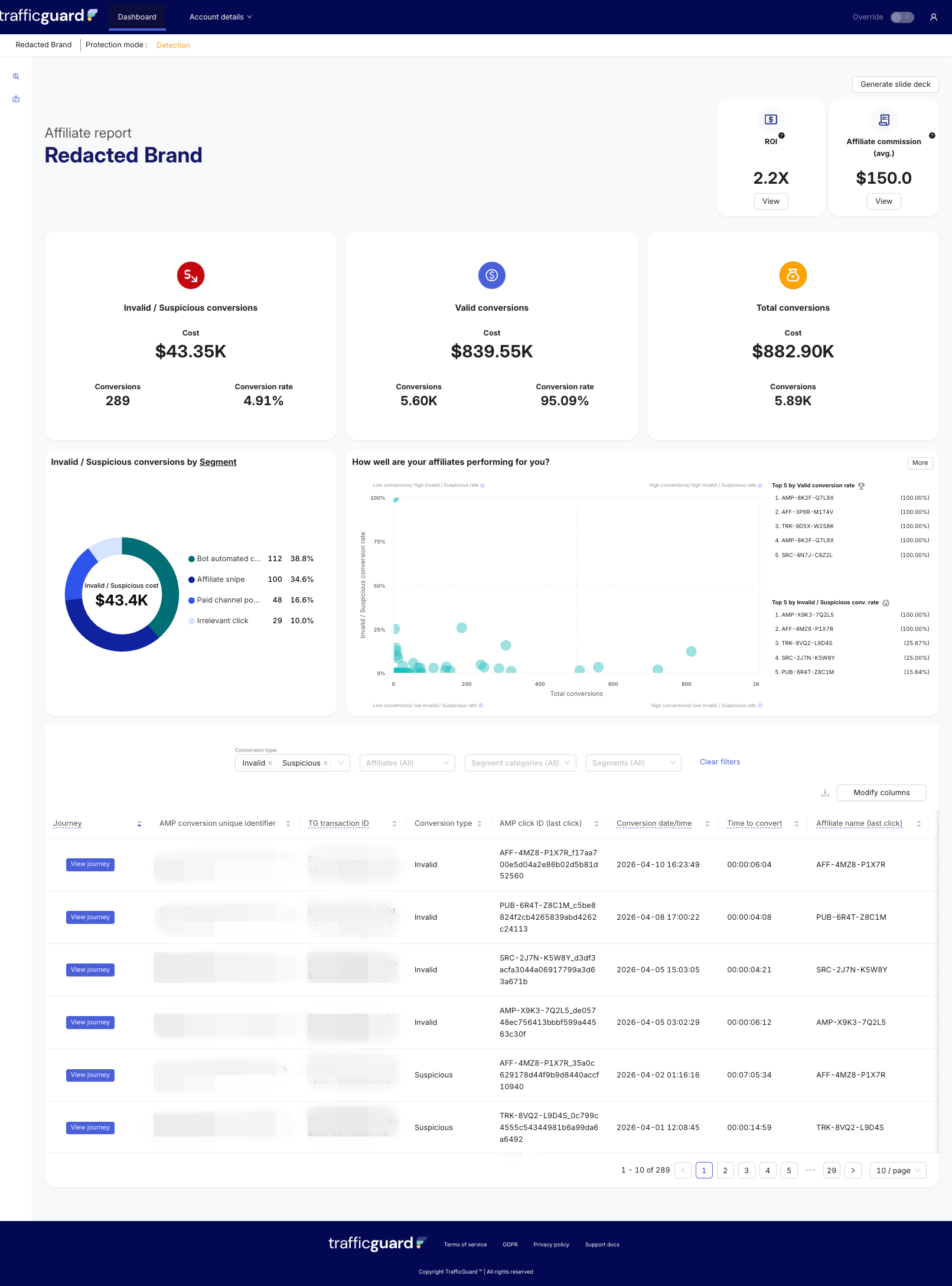
Conversion overview. A high-level summary of total conversions by date range and entry path. This ensures that affiliate, paid media, and internal reporting teams are reviewing the same outcomes before any analysis begins.
Conversion table. Each conversion appears as a structured row, showing the entry channel, affiliate ID, paid click count, journey classification, and final segment category.
Journey timeline. A chronological breakdown of the full path: channel sequence, session IDs, timestamps, attribution changes, and technical detection markers.
Nothing is labelled as bad by default. The dashboard surfaces behaviour. Your team decides what it means.
Where Many Affiliate Reviews Lose Accuracy Early
The first view in the dashboard is a conversion overview across a selected time period and entry points. Nothing is flagged, nothing is blocked, and nothing has been pre-categorised as a problem. The view exists to answer a single but critical question: are all teams reviewing the same completed conversions?
This matters because affiliate platforms, paid media systems, and internal reporting often count conversions differently. Before reviewing attribution quality or partner behaviour, you need alignment on what’s actually in scope. In regulated markets like the UK and US, where compliance expectations and acquisition costs are high, that misalignment carries real financial and governance risk.
How TrafficGuard’s Affiliate Platform Extends Beyond Standard Reporting
Most affiliate platforms are built to report attribution. TrafficGuard’s is built to validate it. That distinction changes how reviews are conducted from the ground up.
Traditional affiliate reporting answers one question: who received the last click? Journey-level validation asks something harder. Where did the user actually come from? Did attribution shift mid-session? Were there multiple affiliate clicks with no engagement behind them? Did paid search acquire this user first? Were any deterministic bot signals triggered along the way?
The review starts with the completed conversion and works backwards through every step. That shift in perspective changes what becomes visible, because when you stop analysing commissions and start analysing behaviour, patterns that previously looked normal begin to stand out.
When A Conversion Becomes A Journey, Not A Stat
Scrolling down through the conversion table, each row represents a completed outcome rather than a partner relationship. Most journeys look clean and direct: a user arrives, engages, converts. Some do not.
Affiliate Snipe
In one reviewed conversion, the system flagged the journey as an Affiliate Snipe. The user first arrived independently via a referral, then returned through organic search. An affiliate click appeared just 3 seconds later, near the end of the journey.
The conversion happened shortly after, within the attribution window. Despite receiving full credit, the affiliate did not introduce the user.
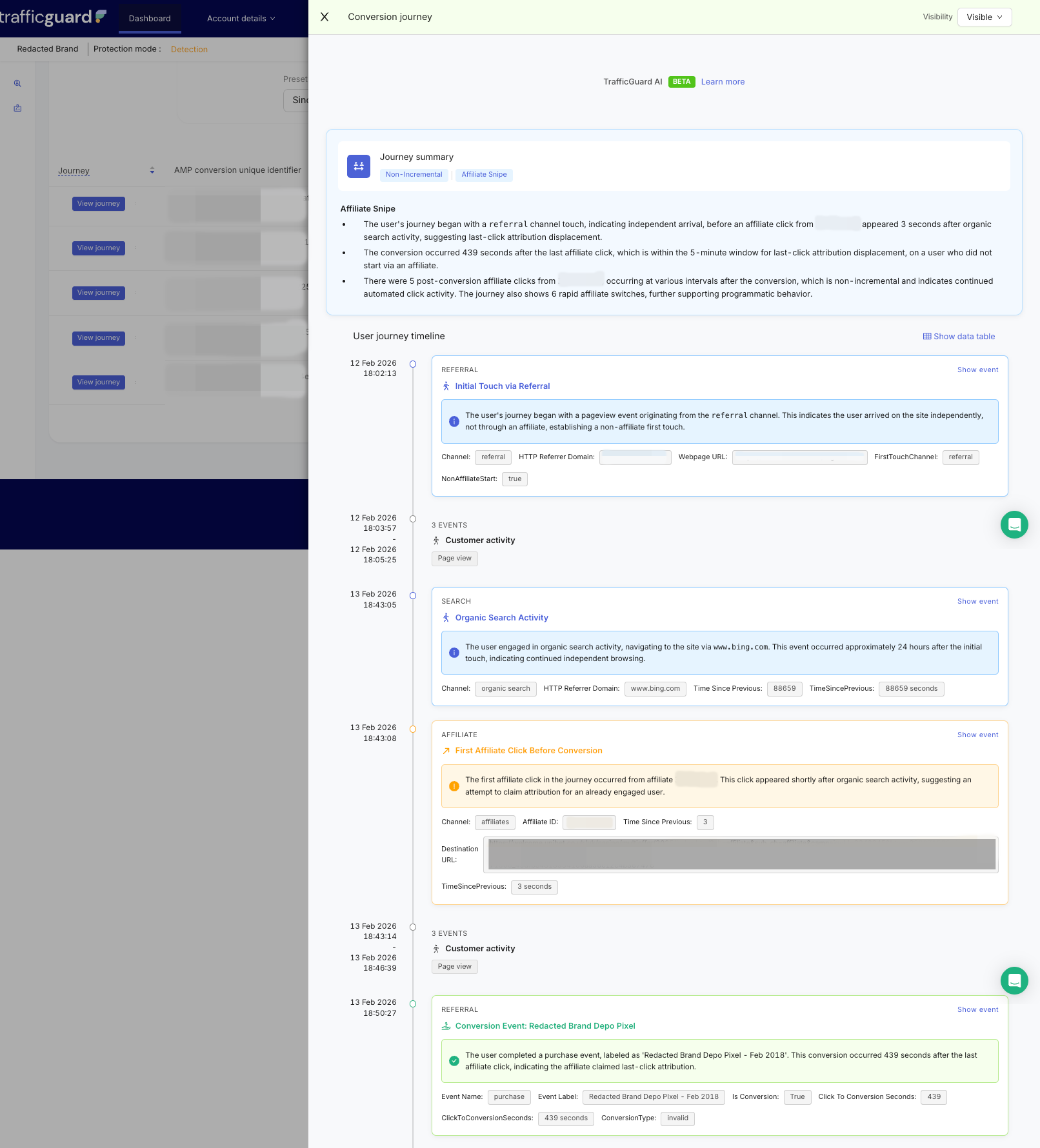
The signals were clear: a non-affiliate origin, minimal engagement, and affiliate activity clustered around the point of conversion. Under last-click attribution, this would appear entirely legitimate. With journey-level validation, it becomes clear the credit was not earned.
The Question That Always Comes Up Eventually
At this stage in the review, the nature of the analysis changes. You’re no longer looking at a number. You’re looking at behaviour. The timeline shows entry channel, session sequence, time to conversion, and attribution shifts. The key question becomes a simple one: did the affiliate meaningfully introduce this user, or did they simply appear near the end of a journey they had nothing to do with?
Paid Channel Poach
In another journey, the system flagged a Paid Channel Poach.
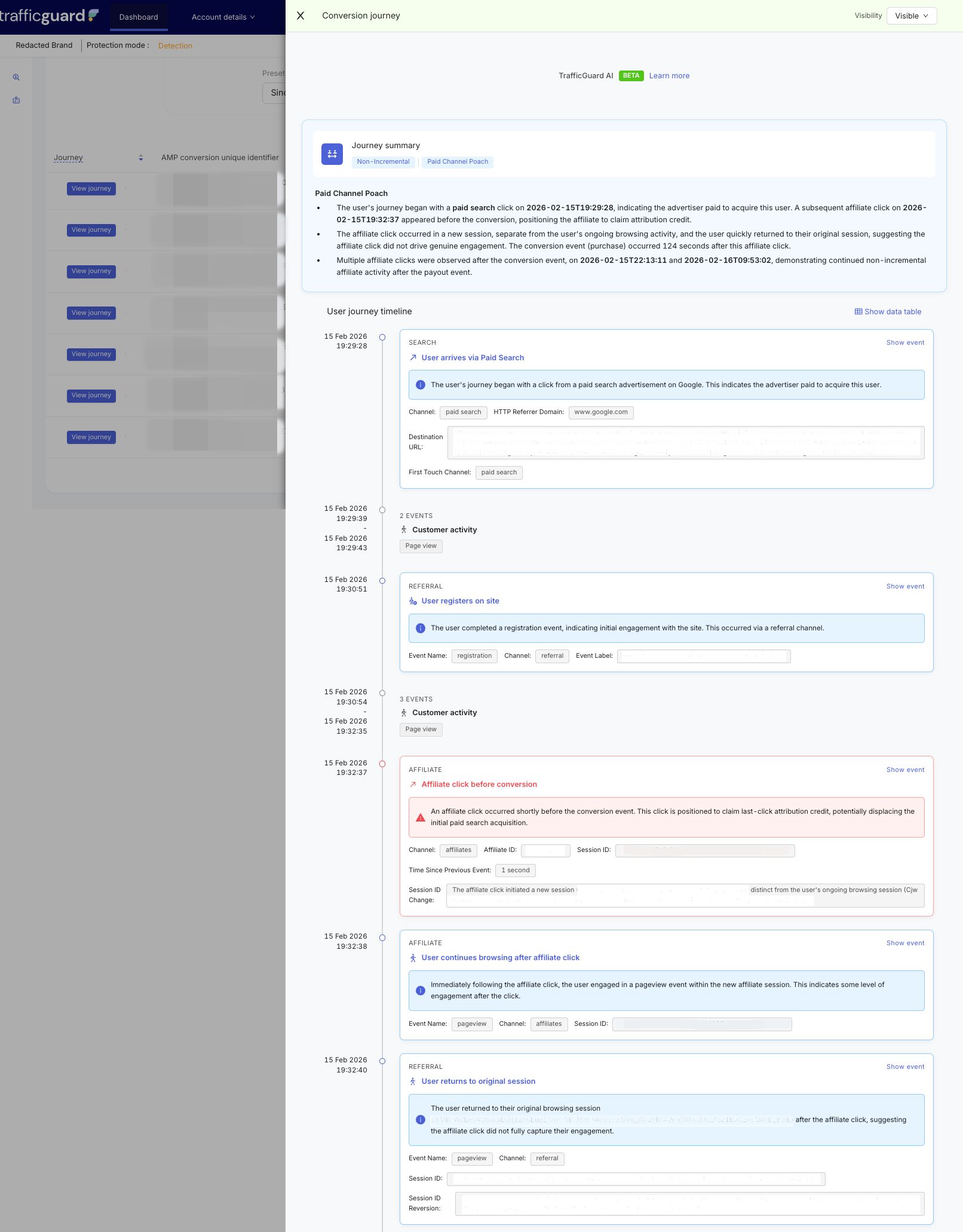
The user originally entered via paid search on 2026-02-15 at 19:29:28, meaning the advertiser had already paid to acquire them. An affiliate click appeared shortly after, just before the conversion.
The user converted 124 seconds later. Despite receiving credit, the affiliate did not drive the initial visit or meaningfully influence the journey. Additional affiliate clicks were recorded after the conversion, reinforcing the non-incremental nature of the activity.
This behaviour isn’t necessarily malicious. It’s non-incremental. And without journey-level validation, the duplication of cost stays hidden.
Why Technical Signals Matter In Affiliate Fraud Protection
Not every issue in an affiliate programme is an attribution problem. Some are deterministic.
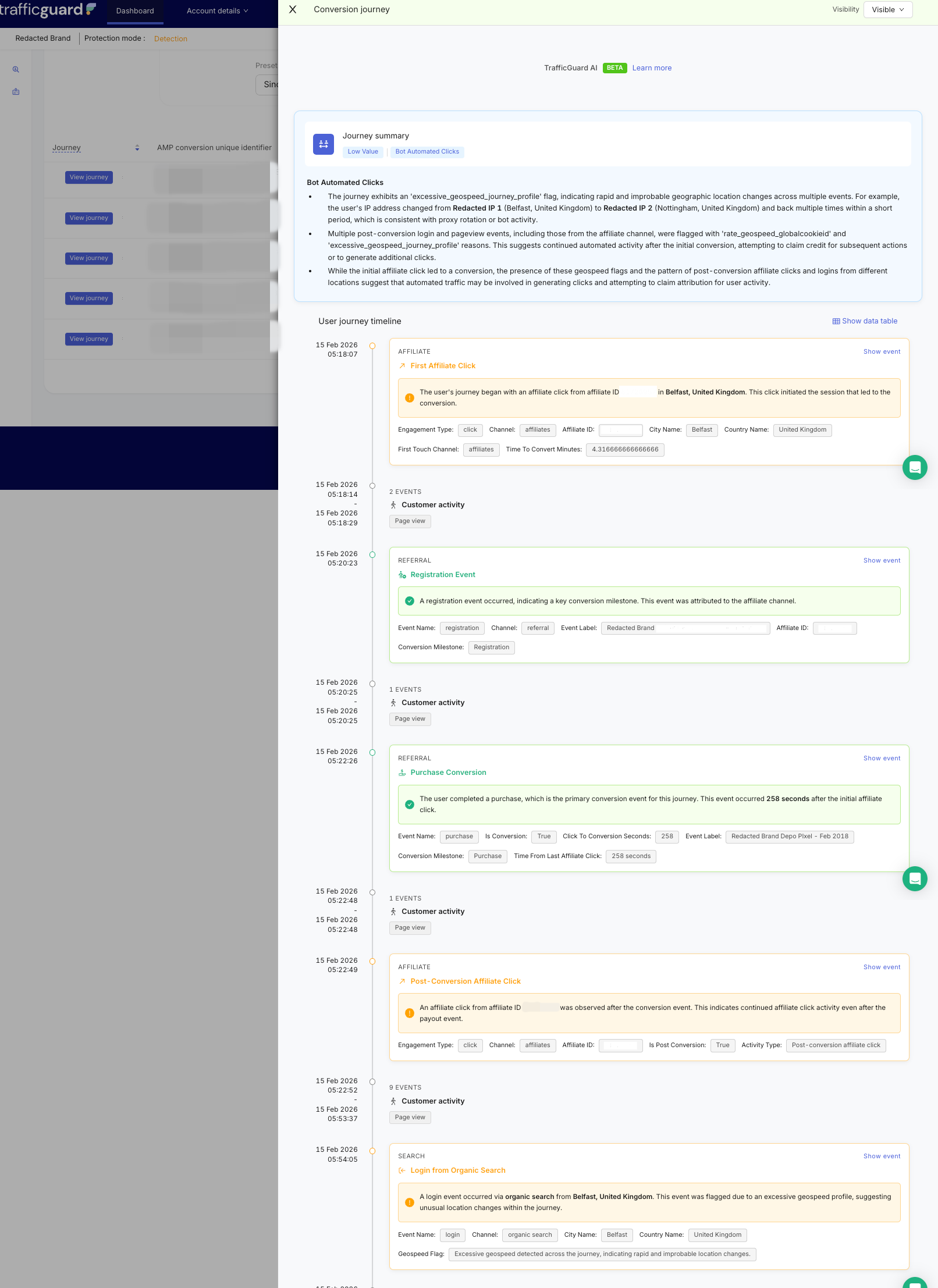
Bot Automated Click
In one reviewed conversion, the system flagged the journey as Bot Automated Click.
The journey showed rapid location changes between cities in the UK within seconds, behaviour that is not possible for a real user.
The conversion was followed by additional clicks and login activity from different locations, indicating continued automated interaction after the event. While the conversion was initially attributed as valid, these patterns pointed to non-human activity rather than genuine engagement.
This conversion was classified as Invalid based on deterministic signals, not behavioural assumption. Without affiliate fraud protection, the commission would have been paid. With journey validation, it was excluded.
Why Session Changes Matter More Than They Appear
As more journeys are reviewed, session changes emerge as a consistently meaningful signal. In normal browsing, sessions are sticky. When a new session ID appears immediately before an attribution shift, that warrants attention.
Sometimes this aligns with legitimate payment or verification flows. Other times, it aligns with attribution overwrites. The value is in knowing precisely when the shift occurred, not just that it did.
When Paid And Affiliate Channels Quietly Intersect
As affiliate programmes expand across the UK, Europe, North America, and emerging regulated markets, channel overlap becomes increasingly common. A user might enter via paid search, return organically a few days later, click an affiliate link, and convert shortly after. Without full journey visibility, the affiliate receives credit for the full outcome.
With affiliate fraud protection, teams can evaluate paid channel origin, affiliate timing proximity, engagement depth, and whether any genuine incremental discovery took place. That’s what moves affiliate validation from reactive auditing into something closer to strategic governance.
When Patterns Replace One-Off Explanations
A single Affiliate Snipe can be dismissed. A single Paid Channel Poach can be written off as coincidence. A single bot conversion can be treated as an edge case. But patterns tell a different story.
When affiliate clicks consistently cluster without engagement, when paid channel overlap occurs within seconds across multiple partners, when deterministic bot rules trigger on a regular basis, and when attribution shifts cluster near deposit events, reviews stop being investigative. They become operational. Affiliate fraud protection becomes embedded in how the programme is governed, not just how it is audited.
Last Click Is Not Wrong. It Is Incomplete.
Last-click attribution remains genuinely useful. It’s simple, consistent, and widely adopted for good reason. But on its own it cannot surface attribution overwrites, non-incremental overlap, deterministic bot activity, or technical session anomalies. Once the earlier steps of a journey are visible, attribution becomes contextual rather than absolute.
Why This Matters As Affiliate Programmes Scale
Affiliate attribution rarely fails loudly. It drifts quietly: one overwritten click, one non-incremental commission, one bot-originated conversion at a time. Effective fraud protection for an affiliate programme isn’t about assuming bad intent across your partner base. It’s about validating journey origin, identifying deterministic bot signals, separating incremental from non-incremental credit, and ensuring commissions actually reflect genuine contribution.
As programmes scale across partners, markets, and acquisition channels, that visibility becomes essential rather than optional.
Frequently Asked Questions
What is affiliate fraud protection and why does it matter in regulated markets like the UK and US?
Affiliate fraud protection validates whether affiliate-attributed conversions are legitimate, incremental, and correctly assigned. In regulated markets such as the UK and US, inaccurate attribution can inflate commission payments and distort reporting. Journey-level validation ensures affiliate payouts reflect genuine contribution rather than overwritten or automated activity.
How can I tell if my affiliate programme is paying for non-incremental traffic?
Common indicators include affiliate clicks occurring seconds before conversion, paid search users later reassigned to affiliates, or multiple affiliate clicks without meaningful engagement. Reviewing the full journey timeline reveals whether the affiliate introduced the user or appeared at the end of an existing path.What is an affiliate snipe?
An affiliate snipe occurs when one affiliate attempts to overwrite another partner’s attribution through rapid click clustering or post-conversion clicks. Without journey-level validation, this behaviour may be incorrectly rewarded under last-click attribution.
What is paid channel poaching in affiliate marketing?
Paid channel poaching happens when an affiliate takes credit for a user originally acquired through paid search or another owned channel. This results in double payment: once for paid acquisition and again via affiliate commission. Journey-level validation identifies when affiliate clicks occur in close proximity to paid channel interactions.
How does affiliate fraud protection detect bot traffic?
Modern affiliate fraud protection relies on deterministic technical signals, including known automation-linked IP ranges, abnormal browser hardware concurrency, triggered technical detection rules, and unnatural time-to-conversion patterns. These rule-based markers provide clear evidence of non-human traffic.
Is last-click attribution still relevant?
Yes. Last-click attribution remains useful for simplicity and reporting consistency. However, it does not provide full journey context. Affiliate fraud protection complements last-click reporting by validating how conversions actually occur.
Does affiliate fraud protection block traffic automatically?
Effective solutions focus first on visibility and validation. The goal is to distinguish between deterministic invalid traffic, non-incremental overlap, and genuine incremental contribution.
Get started - it's free
You can set up a TrafficGuard account in minutes, so we’ll be protecting your campaigns before you can say ‘sky-high ROI’.

Explore More Blogs



Subscribe
Subscribe now to get all the latest news and insights on digital advertising, machine learning and ad fraud.


