

Stolen Commission: How Affiliate Misattribution Is Draining Sports Betting Budgets

Sports betting operators often assume affiliate marketing is straightforward: you pay for outcomes, and you expect those outcomes to be attributed to the right partner. In practice, attribution can be manipulated, sometimes subtly, sometimes at scale, turning what looks like “marketing spend” into stolen commission.
In recent affiliate audits, TrafficGuard has seen a different reality: nearly $220,000 can be wasted through misattribution, and 5% to 10% of transactions can be impacted by cookie stuffing schemes. The fraud landscape is expanding quickly too, growing 64% year over year in this channel category.
The common thread behind these losses is simple: follow the money. When payouts are tied to high-value events like first-time deposits (FTDs) and those events involve CPAs that aren’t small, attribution fraud becomes a profitable strategy.
This blog breaks down what affiliate misattribution looks like, why it’s accelerating, what it costs beyond “bad traffic”, and how operators can get visibility early enough to act.
Want to see the real attribution journeys, fraud patterns, and investigation methods discussed in detail? Watch the full webinar: Affiliate Misattribution in Sports Betting: When “Risk-Free” CPA Isn’t Risk-Free
The Hidden Cost Of Misattribution: It’s Not Just Wasted Traffic, It’s Stolen Commission
If affiliate channels were only a problem of fake leads or bots, the impact might feel limited to “lower quality”. But misattribution changes the economics.
You are effectively paying affiliates for customers they didn’t truly drive, either because the attribution was injected after the fact, or because cookies persisted beyond the affiliate’s real influence.
Misattribution is not wasted traffic, it is a stolen commission.
A Practical Way To Define The Problem
Think of affiliate attribution as a chain. The operator wants the chain to reflect causality: the affiliate click leads to engagement, deposit, and then payout. Misattribution breaks that chain by inserting affiliate value at the wrong time, or rewriting the trackable identity of the user where the affiliate had no meaningful role.
That leads to two major harms:
- You pay twice for the same customer (E.g., paid media plus an affiliate commission on top).
- You scale with blind data, reallocating budgets toward partners who appear “successful” only due to fraud patterns.
In short: misattribution doesn’t just skew reporting, it changes what you fund.
Why Affiliate Misattribution Keeps Growing (64% YoY)
Several incentives make affiliate misattribution increasingly attractive for bad actors.
High CPA And FTD Payouts Create Strong ROI For Fraud
Sports betting and iGaming affiliate models often pay based on FTDs. When a single conversion can involve significant payouts, even small manipulation percentages can produce outsized returns.
Revenue Share Can Reward Players The Affiliate Never Earned
Some agreements include revenue share. As long as players spend time on the platform, the affiliate may receive revenue share, even if the player’s journey was never meaningfully associated with that affiliate.
Bonus-Driven Offers Become A Magnet
Bonus promotions can be structurally exploited. When affiliates promote high-intent offers, fraudsters can target attribution rules instead of real user acquisition.
Cookie And Click Manipulation Can “Move” Credit Weeks Later
Cookie stuffing is particularly damaging because it can outlast the user’s real session. Once a cookie is injected, it can last for weeks or even months until it expires, meaning a conversion may be attributed to an affiliate long after that affiliate had any influence.
PPC Channel Poaching Escalates Overlap Between Paid Media And Affiliate Credit
Affiliate activity can overlap with paid-search journeys, creating cases where PPC-acquired players are later credited to affiliates. This creates scenarios where:
- paid media teams see conversions from Google Ads,
- affiliate dashboards attribute the same deposits to partners via injected tracking.
The end result is a commission stack that should never happen.
What Affiliate Misattribution Looks Like In Real Journeys
Misattribution isn’t always obvious from a summary report. It becomes clear when you analyse session timing, user behaviour, and injection patterns across the full journey. Here are common patterns operators can look for.
Pattern A: Parameter Injection After An Organic Visit (Low Engagement, Sudden Affiliate Credit)
In one example, a user arrived via an organic Google search and landed on a casino page. Just two seconds later, a parameter injection occurred, and the system attributed the user to an affiliate, despite the user never leaving the operator’s website.
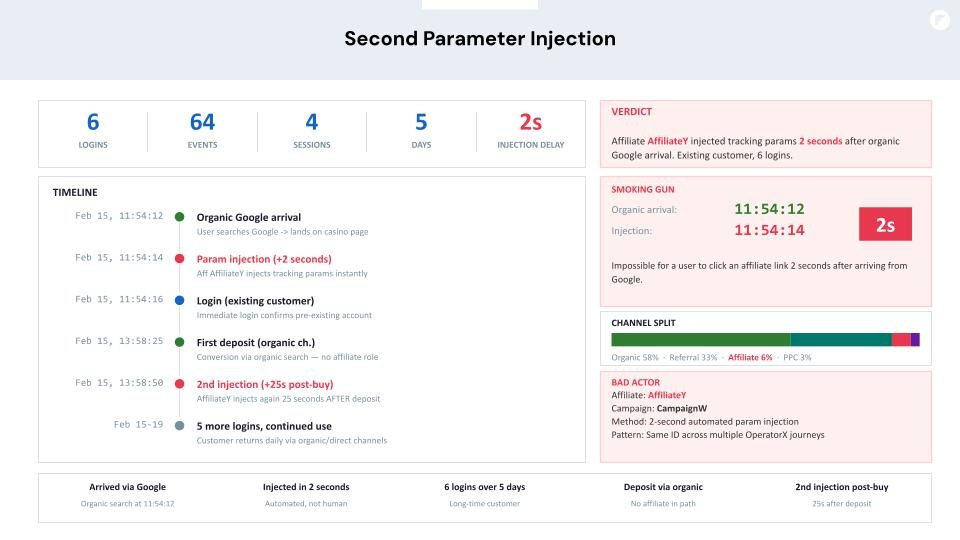
Why this matters: it’s highly unlikely a real user would navigate from an organic search to a separate affiliate site and return within seconds, complete login, and then deposit, especially if the affiliate journey shows only a trivial interaction.
The behavioural signal is clear. The affiliate interaction can be just a click (around 6% of the journey), yet the deposit is attributed to that affiliate.
If affiliate attribution appears within seconds of an unrelated entry channel (organic, referral, direct), and affiliate engagement is minimal, investigate automated parameter injection.
Pattern B: Cookie Stuffing That Credits Conversions Weeks Later
Cookie stuffing works differently from click injection. Once the cookie exists, it can persist. That persistence can create “false ownership” of future conversions.
One described scenario:
- The user arrived via a direct URL and had already logged in eight separate times, making it highly unlikely this was a newly acquired player.
- An affiliate click injection occurred early in the journey, but no meaningful affiliate engagement followed.
- Four days later, an FTD still ended up attributed to the affiliate because the cookie remained active in the background.
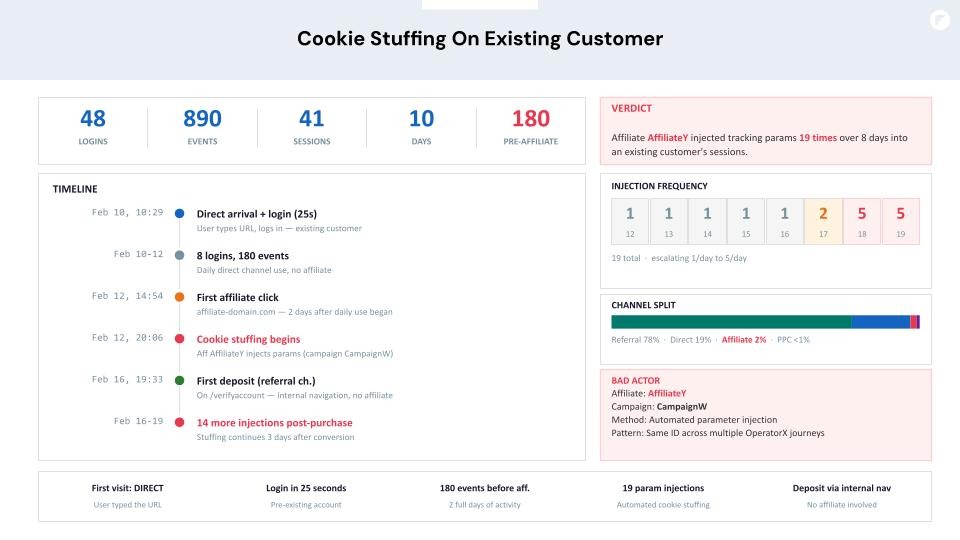
The key takeaway: even when the user later returns directly and takes no affiliate offer, the attribution remains contaminated.
Pattern C: Post-Registration Injection (Affiliate Credit After Verification)
A more subtle but common fraud pattern involves injections around or after registration.
In one case:
- The user arrived via organic Google.
- They completed registration and verification.
- Zero affiliate engagement appeared in the visible journey.
- A first injection occurred, followed by additional click injections appearing seconds apart before and after deposit activity.
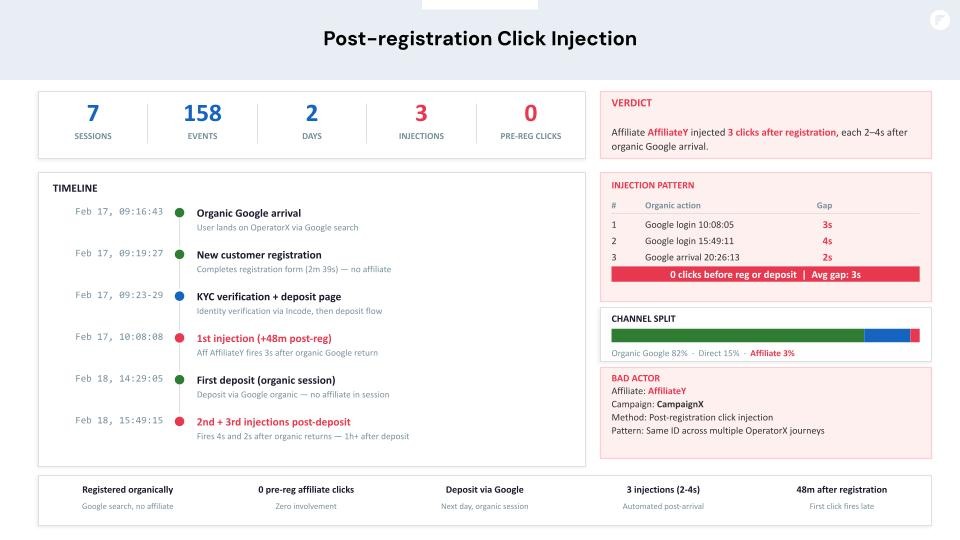
The fraud signal here is timing. Repeated injections occurring only seconds apart, particularly after registration and verification, often resemble automated attribution manipulation rather than genuine human behaviour.
Step-By-Step Investigation
- Identify journeys with organic or direct acquisition.
- Check whether affiliate engagement exists before deposit.
- Look for injections that occur during or after registration, especially with repeated injections spaced seconds apart.
- Confirm whether cookies remain attributed despite no affiliate interaction.
Pattern D: PPC Channel Poaching (Paid Media Click + Affiliate Commission Layered)
This is the scenario that makes operators feel like they’re “paying twice”, but the truth is worse than duplication. The affiliate commission may be earned without incremental acquisition.
In one example:
- The user came from Google paid search (PPC).
- They completed registration, MFA and 2FA, and security setup.
- Affiliate injection occurred mid-setup, while the player was actively progressing toward deposit.
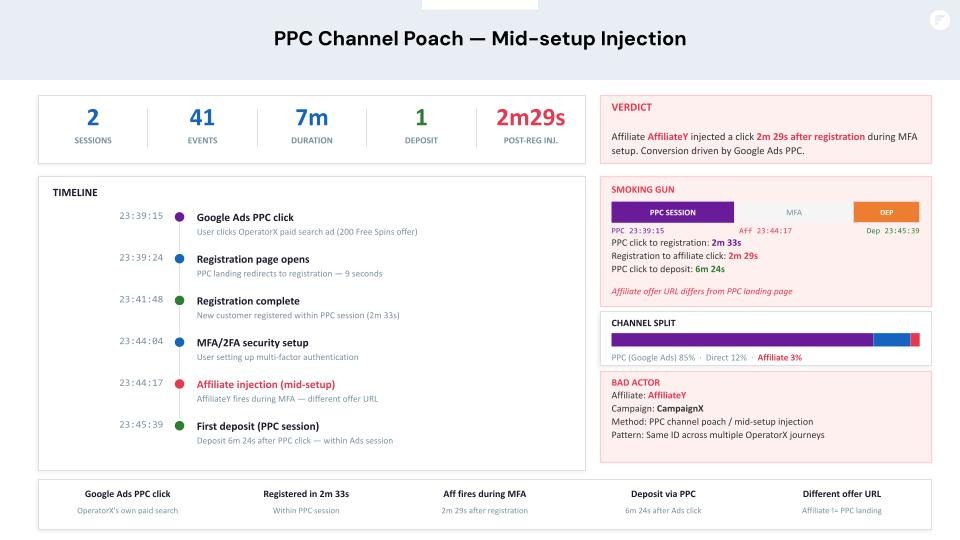
Because the affiliate credit is injected after the player is already deeply engaged through PPC, the affiliate effectively intercepts attribution rather than driving acquisition.
The result is layered acquisition cost on a player already acquired elsewhere.
Why Manual Affiliate Disputes Fail (And Why Month-End Reporting Is Too Late)
Even when operators suspect problems, the operational burden is heavy.
Affiliate teams often must:
- review affiliate management platform (AMP) logs,
- identify questionable conversions,
- assemble evidence,
- and dispute commissions, usually after payouts, which typically occur the next month.
That delay can mean you’re too late to prevent the loss, only able to contest it. Many teams check manually, and it normally takes weeks, while payouts and reconciliation happen later.
So the real need isn’t just better reporting. It’s faster, journey-level visibility that supports mid-month action.
How TrafficGuard Adds Visibility: From Click Capture To Multi-Day Journey Segmentation
The core approach is to follow attribution across the full user journey rather than relying only on the affiliate platform’s summary view.
Capture From The Click (Not Just After The Fact)
Operators insert tracking URLs in their AMP platform. TrafficGuard captures signals from the click, which provides the origin context needed for analysis. The platform works alongside the major affiliate management platforms used by sportsbooks, including RavenTrack, NetRefer, Income Access and Cellxpert, and is agnostic to in-house systems.
Become “The Person In The Middle” During On-Site Behaviour
After the player is redirected to the landing page, the system tracks user behaviour while on the operator site and observes hundreds of signals across multiple days.
Segment Journeys And Detect Likely Misattribution
TrafficGuard’s latest AI-powered classifier analyses full user journeys to uncover patterns linked to affiliate misattribution and attribution manipulation across multiple fraud segments, including:
- Click injection: fake affiliate clicks inserted moments before a conversion to hijack attribution.
- Irrelevant click: affiliate interactions with no meaningful connection to the conversion that followed.
- Paid-channel poaching: affiliates claiming commission on users originally acquired through paid media channels such as Google Ads or Meta campaigns.
- Non-paid channel poaching: affiliate attribution layered onto users who originally arrived through organic, direct, referral, or other non-paid sources.
- Affiliate sniping: last-moment affiliate attribution introduced near deposit or conversion events to steal commission credit.
- Bonus abuse: journeys showing signs of promotional or signup offer exploitation rather than genuine player acquisition.
Instead of looking at a single click in isolation, the classifier follows the full journey: when the user arrived, how they engaged, where attribution changed, and whether the affiliate interaction genuinely influenced the outcome.
That makes it easier to spot the difference between a partner driving real incremental value and one appearing at the final moment to capture commission they did not earn.
The result is not just a fraud flag. It is a clearer picture of how attribution actually unfolded across the conversion path.
Using Insights To Improve Affiliate Partner Management (Without Punishing Legit Partners)
A critical nuance: top affiliates are not necessarily good or bad by default.
Something counter-intuitive shows up in affiliate rankings: some of the highest-volume affiliates are also among the worst performers in suspicious conversion rate.
Without visibility into attribution quality, operators risk scaling interception rather than genuine acquisition, rewarding the affiliates best at capturing credit instead of the ones bringing real players.
For example, one partner might drive the largest number of conversions but show a higher portion of invalid or suspicious outcomes. Operators can then:
- adjust partner status or review requirements,
- focus disputes on the highest-risk conversions,
- and protect the partners bringing genuine incremental value.
That’s how attribution visibility becomes a partner-management advantage rather than a blame game.
The Attribution Risks Operators Can’t Ignore
Affiliate misattribution is no longer a niche issue. It’s a growing attribution problem driven by incentives, automation, and persistent tracking mechanisms.
- Misattribution directly impacts commission accuracy and acquisition economics.
- Cookie stuffing can persist for weeks or months, crediting conversions unrelated to true affiliate influence.
- Timing matters. Injections within seconds, around setup, or after registration with minimal affiliate engagement, are strong red flags.
- Manual review and month-end reconciliation are too slow. Mid-month visibility enables proactive action.
- Choose visibility that maps to reality. Platforms should capture click origin, track on-site behaviour, segment journeys, and support conversion-by-conversion review.
Get Visibility Early, Pay Only When You Mean It
At the heart of this challenge is a simple operational promise: pay the right affiliates for the right customers. When attribution is compromised, operators do not just lose money, they lose confidence in their acquisition strategy.
TrafficGuard for Affiliate helps operators identify misattribution earlier by capturing signals from the click, tracking behaviour across the journey, and detecting patterns linked to cookie injection, click injection, channel poaching, affiliate sniping, and bonus abuse.
That visibility changes affiliate management from a reactive dispute process into a proactive control layer.
Because in a channel built on paying for outcomes, the only commission worth paying is the one you can prove was earned.
Frequently Asked Questions
What is affiliate misattribution in sports betting?
Affiliate misattribution in sports betting happens when affiliate commission is credited to the wrong partner, or credited when the affiliate did not genuinely influence the player acquisition journey. Common examples include click injection, cookie stuffing, affiliate sniping, and PPC channel poaching. These tactics manipulate attribution rules so operators end up paying commission on players that were acquired organically, directly, or through paid media campaigns instead.
How does affiliate fraud affect sports betting operators?
Affiliate fraud impacts sports betting operators by increasing acquisition costs, distorting attribution data, and creating commission leakage. Operators can end up paying twice for the same player through both PPC advertising costs and affiliate commission payouts. Over time, inaccurate attribution data can also influence budget allocation, campaign optimisation, and affiliate partner decisions.
What is cookie stuffing in affiliate marketing?
Cookie stuffing is an affiliate fraud tactic where affiliate cookies are injected into a user’s browser without meaningful affiliate engagement. Once the cookie exists, it can remain active for weeks or months, allowing future conversions or first-time deposits (FTDs) to be incorrectly attributed to the affiliate even when the affiliate had no real influence on the player journey.
What is PPC channel poaching in affiliate marketing?
PPC channel poaching happens when affiliates claim credit for players who originally arrived through paid media channels such as Google Ads or Meta campaigns. This often occurs through injected affiliate tracking that appears late in the conversion journey, creating overlapping attribution between paid search campaigns and affiliate commission payouts.
How can sports betting operators detect affiliate misattribution?
Operators can detect affiliate misattribution by analysing full user journeys instead of relying only on affiliate platform summaries. Common warning signs include attribution changes seconds before deposit, repeated click injections, minimal affiliate engagement, post-registration attribution shifts, and affiliate activity appearing after a player has already been acquired through paid search or direct traffic.
Why is manual affiliate fraud investigation difficult?
Manual affiliate fraud investigations are time-consuming because teams must review AMP logs, timestamps, attribution records, and user journeys across multiple systems. Many suspicious patterns only become visible when analysing behaviour over multiple days. In most cases, operators only discover the issue after commission payouts have already been processed.
How does TrafficGuard detect affiliate attribution fraud?
TrafficGuard detects affiliate attribution fraud by capturing signals from the click and tracking user behaviour across the full conversion journey. Its AI-powered classifier analyses attribution timing, behavioural patterns, channel overlap, click injection activity, cookie persistence, and conversion sequencing to identify risks linked to affiliate fraud and misattribution.
What types of affiliate fraud does TrafficGuard detect?
TrafficGuard detects multiple forms of affiliate attribution fraud, including click injection, irrelevant clicks, affiliate sniping, cookie stuffing, paid-channel poaching, non-paid channel poaching, and bonus abuse. The platform analyses how attribution changes across the full player journey to identify whether affiliate commission was genuinely earned or manipulated through attribution abuse.
Get started - it's free
You can set up a TrafficGuard account in minutes, so we’ll be protecting your campaigns before you can say ‘sky-high ROI’.

Explore More Blogs



Subscribe
Subscribe now to get all the latest news and insights on digital advertising, machine learning and ad fraud.


