

How TrafficGuard Uses AI for Ad Fraud Prevention

TrafficGuard uses AI for ad fraud prevention in two places. Inside the product, machine learning models score every impression, click and conversion in real time and automatically block invalid traffic before it spends your budget. Inside the company, AI agents run much of the software development, so new protection ships faster than a traditional roadmap allows.
When most companies say they “use AI” they mean they bolted a chatbot onto a help page. TrafficGuard uses it in two places that actively help us move numbers: inside the product that protects your ad spend, and inside the company that builds that product. One keeps fraud out of your campaigns. The other ships protection faster than a traditional roadmap ever could.
Here is how both work, and why it matters if you are spending real money on paid media.
The AI Inside the Product: Real-Time Fraud Detection
TrafficGuard exists to solve one problem: invalid traffic (IVT). IVT drains advertising budgets before anyone notices. Bots click ads. Competitors click ads. Click farms manufacture conversions. Roughly $1 in every $3 spent on digital advertising is lost to bots and invalid traffic, and TrafficGuard’s data shows invalid traffic running at 14% to 22% of paid search clicks, climbing past 40% for Tier 1 operators in the most competitive verticals.
If you spend $200K a month on Google Ads, that is tens of thousands of dollars leaking every month before real customers see your ads. Across its advertiser base, TrafficGuard recovers 22% of budget on average and reports a 10X average return on the platform.
Catching that in real time is not a rules problem. Fraud changes too fast for a static blocklist to keep up. It is a machine learning problem, and that is the engine underneath every TrafficGuard product line: Search, Affiliate, Mobile and Social.
It scores traffic as it arrives, not after the damage. Every impression, click and conversion is analysed the moment it happens. The platform combines behavioural analysis, anomaly detection, classification, and predictive models to decide whether each interaction is genuine or invalid, in real time, not surfaced in a report three days later.
It blocks, not just reports. Detection alone tells you that you lost money. Prevention Mode stops the loss. When TrafficGuard identifies a fraudulent source, it automatically adds constantly evolving smart ranges of IPs to your Google Ads exclusions list via the Google Ads API, so your budget stops feeding traffic that will never convert. No manual lists, no delay.
It gets smarter with every customer. The models are not frozen at launch. Every advertiser’s traffic incrementally trains and refines them, so a new fraud pattern caught on one account hardens protection for everyone. Protection across 10,000+ advertisers means a large, constantly refreshed view of what fraud looks like right now.
It is built for fraud that fights back. The newest threat is AI bots that mimic human behaviour closely enough to slip past simple filters, down to mouse movements, natural scroll patterns and solved CAPTCHAs. As TrafficGuard’s leadership has written, fighting AI-generated traffic with static rules is a losing game. The answer is also AI: behavioural models that spot patterns a human-mimicking bot cannot fake at scale.
The result is the metric performance marketers care about. Cleaner traffic means lower effective CPA, more accurate ROAS, and budget that reaches real buyers instead of click farms.
From Detection to Decisions: Turning Fraud Data Into Budget Moves
Catching fraud is just the beginning. The better question for most marketing leaders is not “how much did we lose?” but “where should the rescued budget go next?”
That is where TrafficGuard’s AI is moving in 2026. The platform already consolidates traffic and conversion data across Search, Affiliate, Mobile and Social. The next layer turns that cross-channel data into recommendations: where invalid traffic is concentrated, which channels quietly underperform once you strip the fraud out, and where to reinvest the savings for the best return.
Affiliate fraud shows the shift in action. Affiliate fraud is rarely a single bad click. It is misattribution buried in a multi-step journey, a real conversion credited to an affiliate who did nothing to earn it. TrafficGuard’s detection engine combines deterministic rules, machine learning and advanced AI, using AI-driven user journey analysis to assess intent and behaviour across the whole journey, not just the final click. That is the kind of forensic call that used to need a human analyst and hours of log reading.
For a CMO, fraud prevention stops being a cost-control line item and becomes a source of cross-channel insight that informs where your budget goes.
The AI Inside the Company: An AI-Native Approach to Fraud Prevention
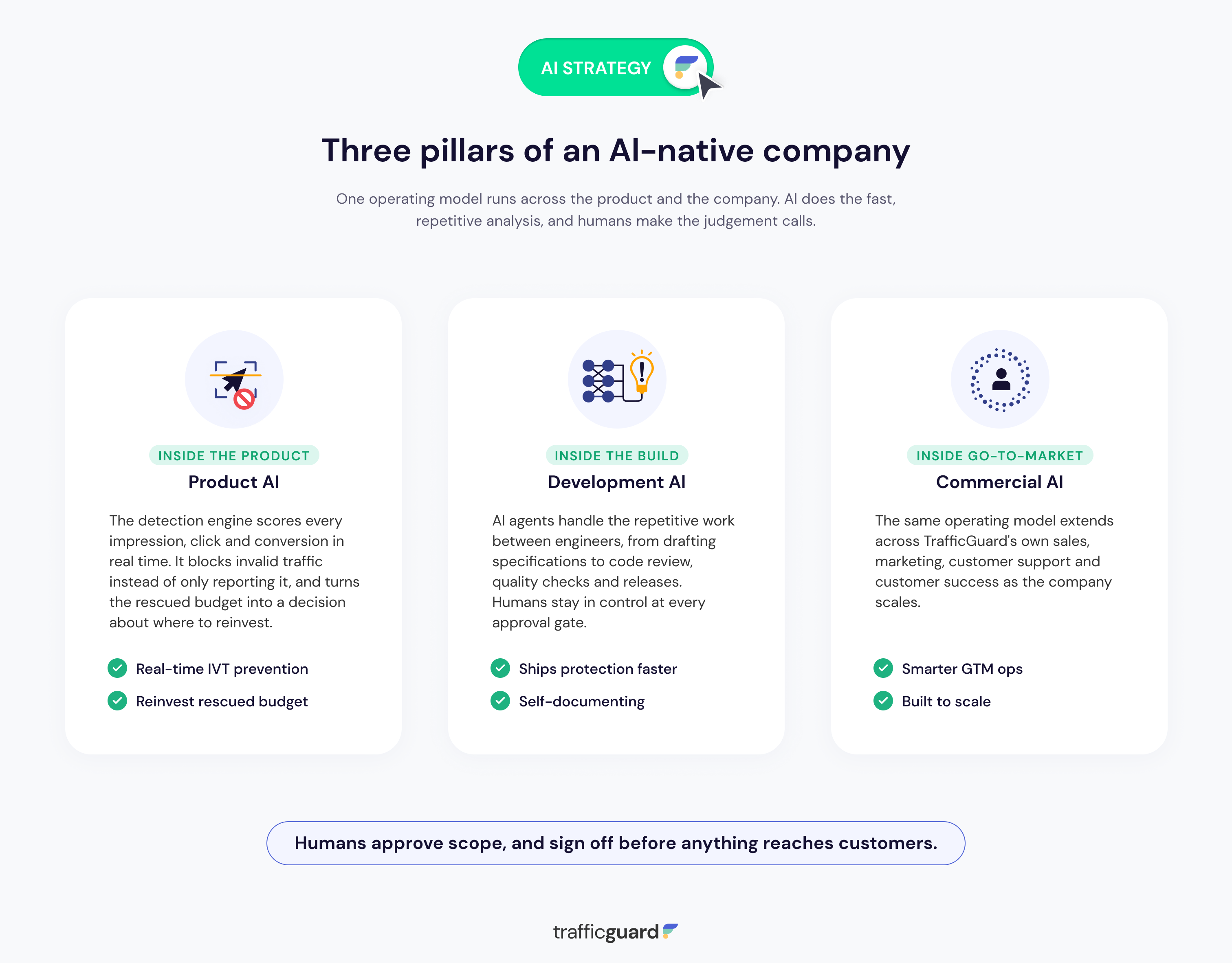
TrafficGuard has set out a public AI strategy built on three pillars: Product AI, Development AI, and Commercial AI.
Product AI is the detection engine described above.
Development AI is the part that changes how fast protection reaches you. TrafficGuard is moving its own software development onto AI agents that handle the repetitive work between engineers, from drafting specifications to reviewing code, running quality checks and preparing releases, with humans keeping control at every approval gate.
Commercial AI applies the same thinking to our sales and marketing operations as we scale.
Humans stay in the process: people approve scope before work starts and sign off before anything reaches customers. And every step documents itself, so the knowledge base stays current without a separate writing effort.
Why an AI-Native Fraud Platform Matters When You Are Buying
A fraud prevention platform is only as good as its ability to keep pace with fraud. Threats are evolving constantly. A vendor that ships once a quarter is always playing catch-up.
By running its own development on AI, TrafficGuard compresses the distance between spotting a new fraud pattern and shipping the protection against it. The same philosophy that powers the product, let AI do the fast, repetitive analysis and keep humans on the judgement calls, runs the company that builds it.
For a performance marketer, that translates to three things. Protection that updates as fast as the threats do. Insight that reaches beyond “we blocked X clicks” into where your budget actually works hardest. And a partner whose entire operating model is built around the same technology you are buying.
That is the difference between a tool that detects yesterday’s fraud and a platform engineered to stay ahead of tomorrow’s.
See AI Ad Fraud Prevention on Your Own Traffic
The fastest way to understand how much invalid traffic is in your campaigns is to measure it. Book a demo and see how much of your paid search budget is reaching real people.
Frequently Asked Questions
How does TrafficGuard use AI to prevent ad fraud?
In two ways. Inside the product, machine learning models score every impression, click and conversion in real time and automatically block invalid sources. Inside the company, AI agents handle much of the software development, so new protection reaches customers faster.
What is invalid traffic (IVT)?
Invalid traffic is any ad engagement that does not come from a genuine potential customer: bot clicks, competitor clicks and click farms. TrafficGuard’s data shows it running at 14% to 22% of paid search clicks, climbing past 40% for Tier 1 operators in the most competitive verticals.
Does TrafficGuard block fraud or just report it?
It blocks. Prevention Mode adds constantly evolving smart ranges of fraudulent IPs to your Google Ads exclusions list via the Google Ads API, so your budget stops feeding traffic that will never convert. No manual lists, no delay.
Can TrafficGuard detect AI-powered bots?
Yes. The newest bots mimic human behaviour down to mouse movements, natural scroll patterns and solved CAPTCHAs. Static rules cannot keep pace, so TrafficGuard uses behavioural models that spot patterns a human-mimicking bot cannot fake at scale.
What does being an AI-native company mean for customers?
TrafficGuard’s parent, Adveritas (ASX: AV1), runs a three-pillar AI strategy across Product, Development and Commercial AI, targeting a tenfold increase in development output by 2027. For customers, that means protection updates as fast as the threats do.
Get started - it's free
You can set up a TrafficGuard account in minutes, so we’ll be protecting your campaigns before you can say ‘sky-high ROI’.

Explore More Blogs


Subscribe
Subscribe now to get all the latest news and insights on digital advertising, machine learning and ad fraud.


