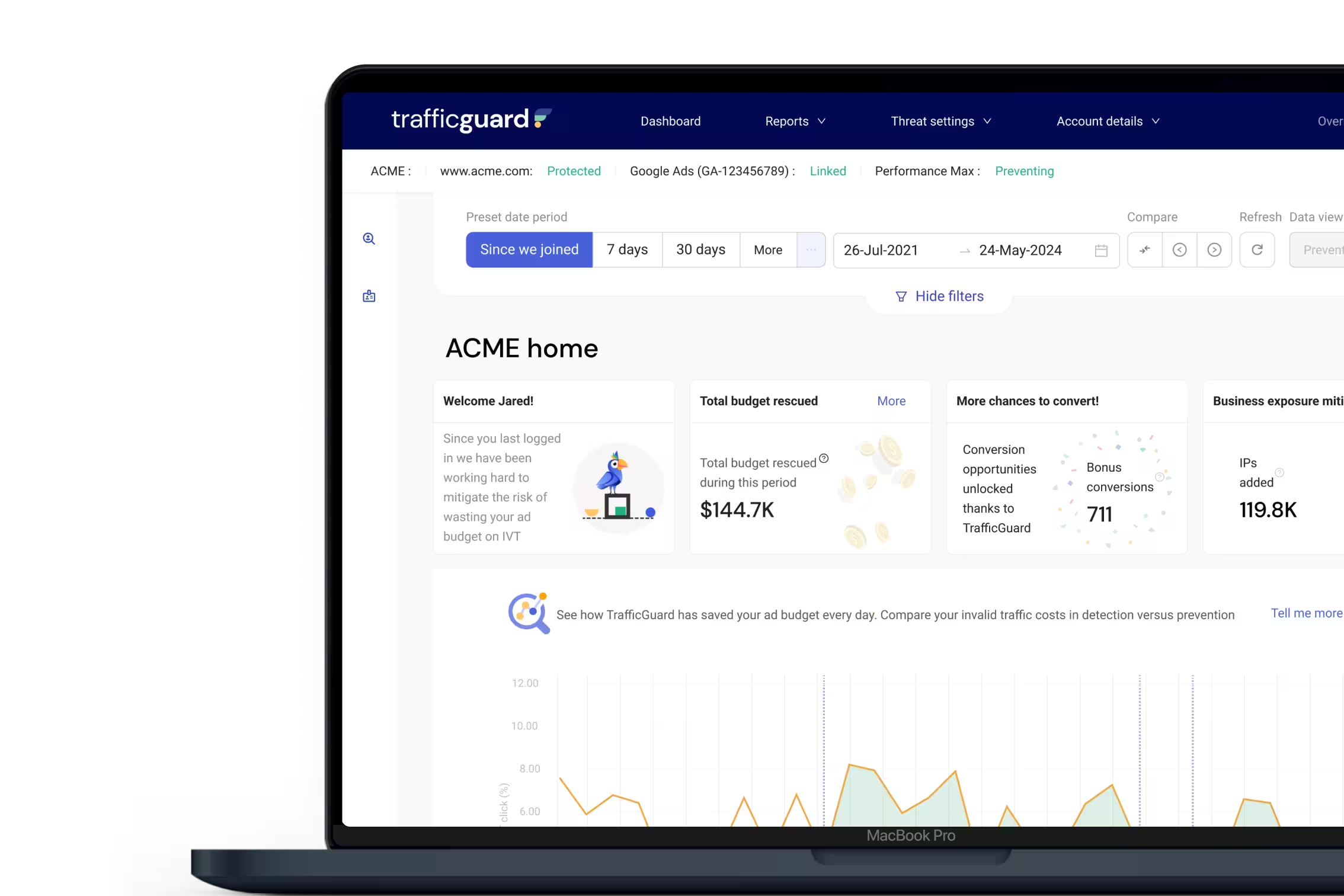
TrafficGuard for Online Marketplaces
Cut CAC Without Cutting Budget
Stop paying for scrapers, ID-rotating bots, and repeat clicks on your high-spend generic keywords. TrafficGuard blocks invalid traffic before it is billed and caps repeat clicks at the user level, so budget stops leaking on clicks that will never convert and goes back to winning net new users. Lower CAC, cleaner bidding data, more margin from every user.















The State of Click Fraud in Online Marketplaces
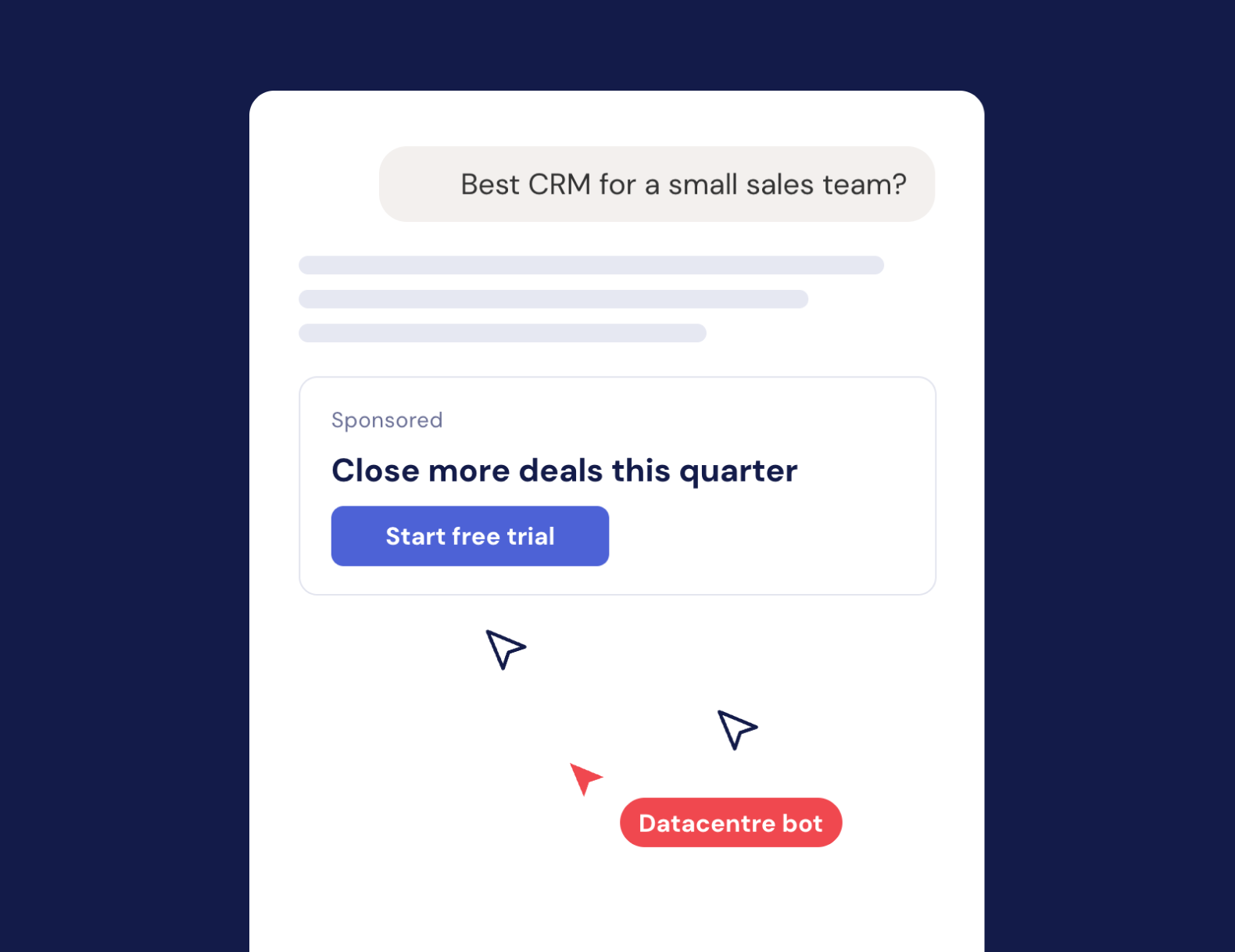
On marketplaces, invalid traffic is a quality problem before it is a volume problem. It arrives looking human, passes platform filters, and records as genuine sessions. Traffic looks healthy; the quality behind it does not. Marketplace ad fraud prevention works by reading behaviour rather than identity.
If a user is going to convert, it happens early. Clicks beyond that point almost never turn into revenue.
repeat clicking expensive generic terms, or loyal customers clicking your branded ad as a lazy gateway to log in. Real people, real clicks, no new business.
as automated bidding optimises toward bot-inflated demand
Your Margin Is Earned Per User. Your Media Is Billed Per Click.
Marketplaces earn margin per user. Ad platforms bill per click. The gap between those two numbers is where paid budgets leak.
TrafficGuard identifies the user behind every click, not just the click. Rotating IPs, new sessions and returning visits resolve to one user, so you can finally see what each user costs to acquire and answer the question that decides profitability: when does it stop being worth paying for this user's clicks?
You set that answer as a ROAS guardrail: the point, based on your gross margin per user, where another click can no longer pay back. TrafficGuard enforces it in real time. With 98%+ of converting users transacting inside their first three clicks, the guardrail cuts almost nothing but waste, and the freed budget goes to users you have never met.
CAC drops
Same conversions, less billed spend. Cutting the clicks that never convert lowers acquisition cost without changing targeting or budget. For OnTheMarket, CAC fell from £2.04 to £1.78, a 13% reduction.
Profit per user rises
When there is a ceiling on what any single user can cost, the margin they bring stays margin. Acquisition cost is set by what a user is worth, not by how often your ads get clicked.
Net new users compound
Freed budget flows to demand you have not met yet. Growth becomes new users, not the same traffic on repeat.
See what a user-level cap would return on your account.
How TrafficGuard Protects Marketplaces from Click Fraud and Invalid Traffic?

Scraper Bots Are Harvesting Your Listings at Full CPC and Slipping Past Your Filters
Block Bots at the Source, Real Time
TrafficGuard reads behaviour, not identity, so a bot that looks brand new on every visit still gets caught, and it is blocked before the click is billed and before it reaches your listings. Detection is trained across the whole network, so a threat pattern identified anywhere is recognised on your account immediately.
Generic Keyword Abuse Is Draining Your High-Spend Terms and Faking Demand
Generic Keyword Protection Built for High-Spend Search
TrafficGuard identifies repeat-click patterns on generic terms and suppresses that traffic before budget is consumed. Those terms stay defended, and bidding decisions reflect real buyers rather than manufactured volume.
Bot Sessions Are Polluting Your Remarketing Audiences and Lookalike Models
Filter Invalid Sessions Before They Reach Your Audience Pools
TrafficGuard filters invalid sessions before they reach your Google or Meta audience pools. Remarketing audiences stay clean, lookalike models are built on genuine buyer behaviour, and retargeting spend reaches people who can transact.
A Small Group of Users Is Eating a Big Share of Budget
User-Level Click Capping Tuned to Gross Margin
TrafficGuard identifies the user behind every click and caps billable clicks at the point your ROAS guardrail says that user stops being profitable to chase. With 98%+ of conversions landing in a user's first three clicks, the cap protects revenue while cutting the waste. Users can still find you and log in. You just stop paying every time they do.
Fake Leads Are Eating Budget and Burning Partner Trust
Lead Validation Before the Conversion Fires
TrafficGuard checks the traffic behind every form fill and booking in real time. Fake leads are blocked before they convert, so they never reach your CRM, your partners, or your bidding data.
Signal Integrity
Protect What Your Bidding Learns
Google's Smart Bidding and Performance Max, and Meta's Advantage+ and lookalike models, learn from every click, session and conversion in your account. That is their strength, and their weakness: feed them polluted data and they will faithfully buy more of it.
The newest bots are built to pass standard checks, so their clicks and form fills land on both platforms as training data. TrafficGuard verifies every impression, click and conversion before it reaches Google or Meta, so the algorithms learn from real buyers only and budget moves back toward the keywords, audiences and creative that actually transact.
Real Results Across Industries I Marketplaces
Real Results for Online Marketplaces
OnTheMarket, one of the UK's leading property marketplaces, was losing approximately £9,500 every month to invalid PPC clicks. With TrafficGuard, the team reduced wasted spend, improved conversion rates and redirected budget towards genuine leads.
5.6%
Invalid clicks identified in the initial audit
22%
Improvement in conversion rate in February 2023
£79k+
PPC budget unlocked and reinvested into genuine leads

Trusted By Leading Marketplace Brands

Protect Your Marketplace Campaigns With TrafficGuard

Choose Plan
We have multiple plans to meet your needs.
Explore Our Plans Details
Unlock Your Protection
TrafficGuard have different plans for different needs, choose the one that fits you best

In-depth Audit
Timeline of getting your site’s in-depth audit results.
What To Expect During the Audit Period?



How To Set Up
Simple steps to set up tracking. Enjoy our full funnel solution for your marketplaces campaigns.
How to set up tracking?


Recommended Resources
Stay up to date with TrafficGuard's latest resources on click fraud protection for marketplace marketers.
















Trusted by Leading Marketplaces Brands












FAQs of TrafficGuard Marketplaces
Can’t find what you are looking for? Go to our support page to learn more.
What is click fraud in marketplace advertising?
Click fraud in marketplace advertising is any paid interaction that consumes acquisition budget without genuine transactional intent. On marketplaces it is dominated by four behaviours: scraper bots harvesting listing data through paid ads, bot networks rotating user IDs to evade detection, competitors and scripts repeat-clicking generic category and destination terms, and non-human sessions entering remarketing pools. What sets it apart from ordinary click fraud is intent: this activity is designed to resemble real user behaviour, so it passes platform filters and appears legitimate in analytics.
Why are my generic category keywords getting clicks but no conversions?
Because generic terms are where invalid activity concentrates. Category, destination and product-type searches represent the majority of marketplace paid Search volume, which makes them the obvious target for competitor clicking and automated traffic and a small group of repeat clickers does outsized damage: 2 to 3% of users can eat up to 20% of budget on exactly these terms. The clicks are real and billable; the intent behind them is not, so volume holds while conversion rate drifts down.
How do I know if scraper bots are clicking my paid ads?
The clearest signal is indirect: high session volume on listing and inventory pages that does not correlate with conversion activity. Scrapers harvesting listing data at scale need to reach those pages, and for a marketplace bidding on its own category terms a paid ad is often the route, charged at full CPC. Because the sessions look organic in analytics, the cost is absorbed as ordinary acquisition spend and never appears as fraud in any report.
Why is my CPA rising when click volume hasn't changed?
Rising CPA on stable volume usually means the composition of your traffic has changed, not the amount. When bots and repeat clickers inflate activity on particular terms, automated bidding reads that as genuine demand and shifts budget toward it. Contaminated signals can raise effective CPA by 20% or more. The volume looks the same because it is the same; what changed is how much of it can transact.
Why is my remarketing underperforming relative to audience size?
Because a share of that audience was never human. Every non-human visit to a listing page can enter your remarketing pool, and those sessions then seed lookalike models, so the platform is being told to find more users who behave like bots. An estimated 30%+ of retargeting budget on marketplace platforms is spent on invalid visitors who will never transact, which shows up as a large audience that converts poorly.
Does website bot protection stop click fraud on paid ads?
No. Website bot protection and marketplace ad fraud prevention operate at different layers. Bot protection defends servers, listing data and user experience, acting at the session level, after the click has already been paid for. TrafficGuard operates at the traffic layer, before the click is charged, so acquisition budget is never consumed in the first place. Most marketplaces need both: one protects the platform, the other protects the spend that fills it.
Can bot traffic get into my remarketing and lookalike audiences?
Yes, and it is one of the least diagnosed costs on a marketplace platform. Any non-human session that reaches a listing page is eligible to enter an audience pool, and once inside it becomes training data for lookalike and similar-audience models. Retargeting spend is then directed at visitors who will never transact, and every campaign built on those models inherits the contamination.
Do Google Ads and Meta already filter out invalid traffic?
They apply their own filtering, but what they report is the picture that remains after that filtering has run. Sophisticated activity is not reliably in it: ID-rotating networks, scraper traffic arriving via paid ads, and persistent low-volume clicking on generic terms all survive platform-level filters. This is also why agency monitoring does not close the gap: agencies work with the data available in Google Ads and Meta, and cannot act on what those platforms never surface.
Why don't IP blocks and audience exclusions stop marketplace bots?
Because both work on identity, and marketplace bot networks are built to change identity. Rule-based and IP-based tools catch repetition; these networks rotate user IDs so no session ever repeats, and the newest bots mimic human behaviour down to mouse movements and solved CAPTCHAs. Exclusions have a second problem, they reduce reach, not behaviour. By the time a visitor is excluded, the session has already happened and already entered your audience pools.
What should marketplaces look for in click fraud prevention software?
Four things: real-time prevention rather than after-the-fact reporting, behaviour-based detection that still works when every session presents a new identity, coverage extending to remarketing audiences and not just Search clicks, and reporting you can audit. Reporting alone protects nothing and; by the time an invalid click appears in a report, the budget is spent and the signal has already reached your bidding models. The practical test is simple: ask what a tool would still catch if every session arrived with a brand-new identity.
How does TrafficGuard compare to Lunio for marketplace ad fraud prevention?
Lunio works primarily on an audience exclusion model by identifying invalid traffic and excluding those users after their sessions have occurred. TrafficGuard blocks invalid and non-incremental clicks in real time, before budget is consumed and before sessions enter audience pools. For marketplaces the distinction matters because the two most expensive consequences, contaminated bidding models and polluted lookalike audiences, are both created at the moment the session happens. Excluding a user afterwards does not withdraw the signal they already contributed, and recovery from a contaminated model takes weeks to months.
How does TrafficGuard compare to ClickCease for marketplace campaigns?
ClickCease is built around rule-based blocking for Google and Meta, an approach oriented toward SMB advertisers and simpler fraud patterns. That model is structurally weak against what marketplaces face, because ID-rotating networks are designed specifically to defeat identifier-based rules where the evasion technique and the detection method are aimed directly at each other. TrafficGuard applies enterprise-grade, behaviour-based detection built for sophisticated bot activity at marketplace scale.
What is user-level click capping?
It is a limit on how many paid clicks you will pay for from a single user, rather than from an IP address or a session. IPs rotate and sessions reset, so caps set there are easy to defeat. TrafficGuard resolves clicks to the user behind them, so the cap follows real behaviour: 98%+ of users who convert do it inside their first three clicks, and once a user is past the point where a conversion is realistic, their clicks stop being billed. The heavy clickers, the 2 to 3% of users who can eat up to 20% of budget, are exactly who the cap catches.
When does it become unprofitable to keep paying for a user's clicks?
When the cost of their clicks passes the gross margin they can return. That threshold is different for every marketplace, which is why TrafficGuard manages it as a ROAS guardrail at the user level: you set the margin maths, TrafficGuard identifies the user behind each click and stops billing once another click cannot pay back. For most marketplaces the guardrail sits early, because 98%+ of users who convert do it inside their first three clicks.
Will capping clicks after the third click cost me conversions?
The data says no. 98%+ of users who convert do so within their first three clicks, so a cap after that point gives up almost nothing and saves every wasted click beyond it. The cap is not fixed at three either: TrafficGuard sets it from your own conversion data and gross margin per user, so it sits wherever your numbers say it should.
Why are loyal customers clicking my branded ads a problem?
Because a branded ad is often the easiest way to log in. Loyal users search your name, click the ad at the top, and you pay full CPC for a visit that was coming anyway. One click is noise. Thousands a day is a budget line. User-level capping keeps paying for the clicks that win new users and stops billing the ones that are just a doorway.
How does click fraud protection reduce CAC on a marketplace?
CAC is spend divided by new customers. Invalid clicks and repeat clicks inflate the spend without adding customers. Remove them and the same conversions arrive on less billed spend, so CAC falls without touching targeting, creative, or budget. Cleaner data then stops bidding algorithms chasing fake demand, which lowers CAC again.
Can TrafficGuard stop fake leads and bot form fills?
Yes. TrafficGuard checks the traffic behind every enquiry, booking and form fill in real time, so fake leads are blocked before they convert. For marketplaces that sell leads to a supply side, that protects three things at once: the budget that generates leads, the sales and partner time spent working them, and the lead quality reputation your commercial model depends on.
What is signal integrity in performance marketing?
Signal integrity is the accuracy of the data your automated bidding learns from: clicks, sessions and conversion events. Platforms like Google and Meta optimise toward those signals with machine learning, so polluted input produces confidently wrong output, and budget follows it. Protecting signal integrity means verifying events before they enter the data. It is also why real-time prevention beats refunds after the fact: a refund returns the money, but the polluted signal has already trained the model.
See what invalid traffic is adding to your CAC