

Black Friday CPC: Is the Google Ads Premium Worth Paying?
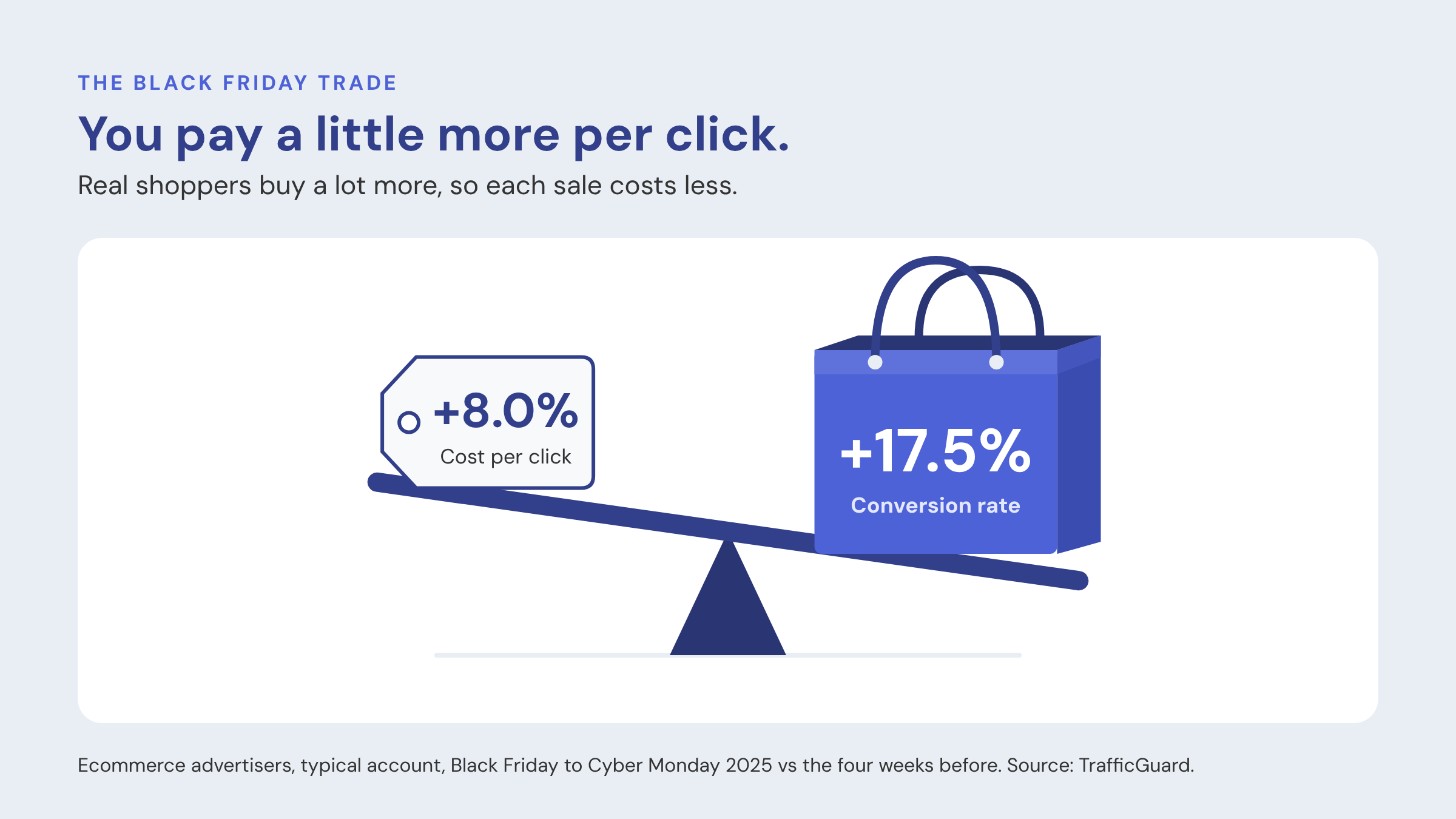
Black Friday Google Ads CPC premium can be worth paying if higher conversion rates offset rising click costs. TrafficGuard's 2025 ecommerce data shows that during Black Friday to Cyber Monday, CPC increased by 8%, while conversion rates rose by 17.5%, resulting in an estimated 8% lower cost per conversion. For Black Friday 2026, advertisers should assess profitability based on cost per purchase, profit margins and the impact of invalid clicks, rather than CPC alone.
Every November, the same question lands in front of ecommerce teams: Black Friday CPC is going up again, so should you keep spending through the peak or hold back? The answer depends less on what you pay per click and more on who is clicking. Using data collected through TrafficGuard’s click fraud protection for eCommerce, we analysed last year’s numbers to understand when the Black Friday premium is worth paying and when it isn’t.
How Much Does Black Friday CPC Increase in Google Ads?
Black Friday Google Ads CPC increased by an average of 8% between Black Friday and Cyber Monday 2025, based on TrafficGuard's sample of eCommerce Google Ads accounts, compared with the previous four weeks.
Despite higher advertising costs during the Black Friday weekend, campaign performance improved:
- Cost per click (CPC): increased by 8%.
- Conversion rate (CVR): increased by 17.5%.
- Cost per acquisition (CPA): decreased by approximately 8%.
Methodology: TrafficGuard analysed 201 ecommerce and retail Google Ads accounts, comparing Black Friday to Cyber Monday 2025 (28 November to 1 December) with the equivalent days in the previous four weeks. Figures represent median account-level changes to avoid skew from larger advertisers. Sample sizes vary by metric, and conversion rates reflect advertiser-defined Google Ads conversions, not necessarily sales.
This table shows how the two numbers combine for a typical ecommerce account.
Why Black Friday ROAS can fall despite higher conversion rates
Higher conversion rates during Black Friday do not always translate into better returns. Optmyzr's 2025 Google Ads analysis found that return on ad spend (ROAS) fell by approximately 22% for standard shopping campaigns between Black Friday and Cyber Monday, compared with the previous week.
TrafficGuard's research uses a different sample of eCommerce advertisers, a four-week comparison period and cost per conversion as its primary metric, so the findings are not directly comparable.
However, both studies highlight an important consideration for eCommerce advertisers: lower acquisition costs do not necessarily mean higher profitability. Lower average order values, deeper discounts and wasted ad spend on invalid traffic can all undermine Black Friday campaign performance, even when conversion rates increase.
Why Higher Black Friday CPC Can Still Lead to Lower Acquisition Costs
Higher Google Ads CPC during Black Friday does not necessarily mean higher customer acquisition costs. For eCommerce advertisers, cost per acquisition (CPA) is often a more meaningful measure of campaign efficiency.
When conversion rates increase faster than CPC, the cost of generating each sale falls, even when advertisers pay more per click.
Here is a simple example. The starting CPC and conversion rate are illustrative; the percentage changes are from our 2025 data.
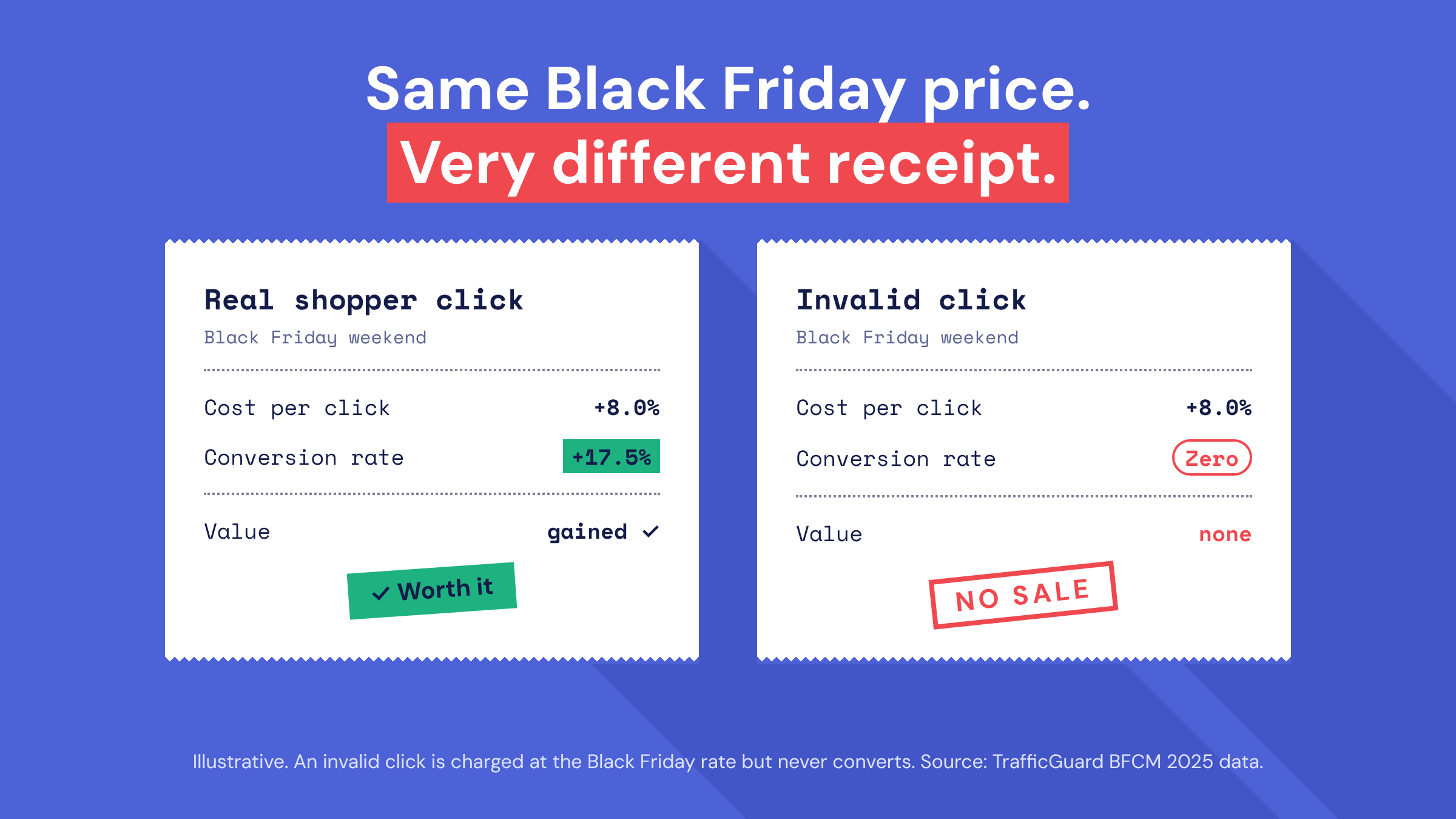
The same budget buys fewer clicks, but each one is more likely to become a sale. Conversion rate rose more than twice as fast as cost per click, so a real Black Friday click was worth more than the premium paid for it. That makes it the worst weekend of the year to pay for clicks that were never going to buy.
That only holds if the clicks are real. For the wider picture beyond Black Friday, our eCommerce resources on click fraud cover how invalid traffic affects ROAS across the year.
Black Friday Click Fraud Wastes Your Google Ads Budget
Higher conversion rates can justify higher CPCs during Black Friday, but only genuine shopping activity creates sales opportunities. Bots, click farms, fraudulent competitor clicks and other forms of invalid traffic can consume advertising budget without generating revenue.
Google Ads filters detected invalid traffic before billing and may issue credits for invalid activity identified afterwards. However, invalid clicks that remain undetected or uncredited still come at a cost.
When Black Friday CPCs rise, so does the potential cost of invalid traffic. Unlike genuine shoppers, fraudulent traffic offers no increase in purchase intent to offset higher advertising costs.
The Black Friday premium is worth paying for genuine shoppers, not invalid traffic.
How Much Invalid Traffic Can Cancel Out Your Black Friday Gains?
Based on TrafficGuard’s 2025 data, Google Ads campaigns generated approximately 8.8% more conversions per dollar during the Black Friday peak. However, it takes relatively little additional invalid traffic to erase that advantage.
In this example, if just 8% of paid clicks were replaced by invalid clicks that generated no sales, the cost-per-sale advantage would disappear. This assumes advertising spend and average CPC remain unchanged and applies only to invalid clicks that remain billed.
How much of your Black Friday advertising budget could be at risk? Use our free invalid traffic calculator to estimate how much of your Google Ads spend could be at risk.
The exact break-even point will vary depending on your CPCs, conversion rate and traffic mix. However, even a relatively small increase in billed invalid traffic can eliminate the cost-per-sale gains achieved during one of the most important trading periods of the year.
Black Friday Google Ads Checklist: 4 Ways to Protect Your Ad Spend
Use this Google Ads checklist to maximise sales, minimise wasted ad spend and ensure the Black Friday premium delivers meaningful returns.
How to Make Every Black Friday CPC Count
TrafficGuard's 2025 Black Friday data shows that higher CPCs do not necessarily mean higher acquisition costs. Despite an 8% increase in CPC, stronger conversion rates drove the cost per conversion down by approximately 8%.
However, even a small increase in billed invalid traffic can erase those gains. For eCommerce advertisers, the priority should not simply be securing cheaper clicks, but generating genuine sales, protecting profit margins and maximising return on ad spend.
The Black Friday premium is worth paying for shoppers, not bots.
See how TrafficGuard's Google Ads click fraud protection helps you reduce wasted ad spend and direct more of your budget towards genuine customers.
Frequently Asked Questions About Black Friday Advertising
Why does CPC increase during Black Friday?
Google Ads CPC typically increases during Black Friday because more advertisers compete for the same keywords, audiences and ad placements. Increased competition drives up auction prices, particularly in eCommerce. However, stronger purchase intent can offset higher advertising costs if conversion rates increase faster than CPC.
How much does Google Ads CPC increase during Black Friday?
TrafficGuard's analysis of eCommerce Google Ads accounts found that a typical account paid 8% more per click between Black Friday and Cyber Monday 2025 than in the previous four weeks. However, conversion rates also increased by 17.5%, resulting in an approximately 8% reduction in cost per conversion. CPC increases vary by industry, competition and campaign type.
Should I increase my Google Ads budget for Black Friday?
Increasing your Google Ads budget during Black Friday can be worthwhile if your campaigns generate profitable sales. Base budget decisions on historical performance, conversion rates, ROAS and profit margins rather than traffic volume alone. Monitor invalid traffic closely to ensure additional advertising spend reaches genuine shoppers.
Is Black Friday or Cyber Monday better for Google Ads?
Black Friday can generate higher conversion value than Cyber Monday, although performance varies by product category, audience and promotional strategy. Review your historical campaign data, including cost per purchase, conversion value and ROAS, to determine how to allocate your advertising budget across the two events.
Should you use a seasonality adjustment in Google Ads for Black Friday?
Seasonality adjustments can be useful when you expect an unusually large change in conversion rates during a short promotion. Google recommends using them for events lasting one to seven days. As Smart Bidding already accounts for regular seasonal patterns, adjustments should be reserved for significant changes that the algorithm may not anticipate.
How do I know if a higher Black Friday CPC is worth it?
A higher CPC can be worth paying if conversion rates increase sufficiently to reduce the cost per purchase or improve ROAS. Advertisers should also consider average order values, discounts and profit margins. Higher advertising costs are only worthwhile when they generate profitable sales.
How can I prevent click fraud during Black Friday?
Advertisers can reduce click fraud during Black Friday by monitoring unusual traffic spikes, identifying suspicious click patterns, excluding confirmed invalid sources and using dedicated Google Ads click fraud protection. Preventing invalid traffic helps protect advertising budgets and ensures more spend is directed towards genuine shoppers.
Does Google refund invalid clicks?
Google automatically filters detected invalid clicks and excludes them from advertising charges. If invalid activity is identified after billing, Google may issue account credits. However, not all invalid traffic is detected. TrafficGuard's Google Ads refund solution helps advertisers identify billed invalid clicks and recover advertising spend that should not have been charged in the first place.
Get started - it's free
You can set up a TrafficGuard account in minutes, so we’ll be protecting your campaigns before you can say ‘sky-high ROI’.

Explore More Blogs


Subscribe
Subscribe now to get all the latest news and insights on digital advertising, machine learning and ad fraud.


